

Best CBT Ebooks to Try Now, From Free to Publisher-Recommended
Start here: if you want a free workbook to try tonight, The Think CBT Workbook is the best entry point for self-guided practice. If you want a concise primer that explains the theory before you touch an exercise, look for a short cognitive-behavioral overview written by a licensed clinician. If you want a hands-on workbook built for repeated use, Ebook-warehouse’s Anxiety and Depression 101 gives you structured exercises in a downloadable format you can work through on your own schedule.
Each fits a different moment in your process:
- Free workbook (Think CBT): best for testing whether structured self-help suits you before spending money.
- Concise primer: best for understanding why CBT techniques for anxiety work before you commit to daily exercises.
- Ebook-warehouse workbook: best for readers who want worksheets, pacing, and a purchase they can revisit across devices.
Grab the free workbook first. If it clicks, move to a paid CBT workbook PDF built around your specific goal.
Key Takeaways
Structured CBT ebooks work when they combine real exercises with a repeatable weekly routine, not when they’re read passively like a novel.
| Point | Details |
|---|---|
| Start free, then upgrade | Try The Think CBT Workbook before buying anything, then move to a paid title once you know the format suits you. |
| Match format to goal | Choose a workbook for exercises, a primer for theory, or an intervention brief for one specific technique like exposure. |
| Follow a weekly routine | Read one short section, complete its worksheet, apply it once, then review your log every seven days. |
| Watch for red flags | Worsening symptoms or thoughts of self-harm mean it’s time to involve a licensed clinician, not push through alone. |
| Ebook-warehouse workbooks for structured practice | Anxiety and Depression 101 and Developing Emotional Intelligence offer downloadable PDF/EPUB workbooks matched to self-study and emotional-skills goals. |
Table of Contents
- What Makes Something a CBT Ebook, Not Just a Self-Help Book
- Free Cbt Ebooks Worth Downloading Before You Buy Anything
- Choosing A Paid Cbt Workbook Worth Your Money
- A Simple Weekly Routine For Working Through A Cbt Ebook
- What The Clinical Evidence Actually Says About Self-Help Cbt
- The Gap Between A Good Workbook And A Good Excuse Not To See A Therapist
- Where To Find Ebook-warehouse’s Cbt-related Workbooks
- Sources
What Makes Something a CBT Ebook, Not Just a Self-Help Book
Not every book with “cognitive behavioral” on the cover functions the same way. Three formats dominate the category, and picking the wrong one wastes your time.
- Workbooks center on exercises and worksheets. You track thoughts, rate moods, and complete structured prompts. This is the format most people mean when they search for a CBT workbook PDF.
- Primers explain theory and walk through case examples without asking you to fill anything in. Good for building understanding before you commit to homework.
- Intervention briefs target one technique, such as behavioral activation or exposure work, based on the core methods described in clinical texts like Craske’s Cognitive-Behavioral Therapy.
Before downloading anything, check four things: does it include actual worksheets or just narrative advice, does the author list clinical credentials, is the edition recent enough to reflect current practice, and does it come as a PDF (easy to print) or EPUB (better for e-readers with adjustable text size). Printable worksheets matter if you process information better on paper. Interactive e-reader features matter if you’re reading on a phone during a commute.
Free Cbt Ebooks Worth Downloading Before You Buy Anything
Credible free resources exist, and you don’t need to guess which ones are legitimate. Look for three signals: the author holds clinical training (a PhD, PsyD, or licensed therapist credential), the material comes from a university clinic or established therapy-resource publisher, and the worksheets cite the techniques they’re built on rather than presenting vague affirmations as therapy.
Two publishers consistently meet that bar. The Think CBT Workbook offers a full structured program with printable exercises. Psychology Tools publishes clinician-grade worksheets and handouts that show you what a well-built exercise actually looks like.
- Download one printable worksheet, not the entire workbook, on day one.
- Complete just one or two exercises before judging whether the format works for you.
- Keep a simple practice log (date, exercise, one sentence on what you noticed).
Pro Tip: Mark any section that confuses you and set it aside to revisit later or discuss with a clinician, rather than pushing through worksheets that don’t make sense.
Choosing A Paid Cbt Workbook Worth Your Money
Free resources get you started. A paid workbook earns its price when it adds something free PDFs typically skip: sustained structure, disorder-specific focus, and worksheets bundled with explanation rather than scattered across a website.
Before buying, weigh these factors:
- Exercises versus theory. A workbook should be at least half practice, not summary of research.
- Disorder focus. General self-help differs from a book built specifically around anxiety, depression, or emotional regulation.
- Clinical detail level. Some readers want plain-language guidance; others, especially those studying CBT professionally, want technique names and rationale.
- Format access. Confirm PDF and EPUB availability so you can read on a laptop or a phone.
- What’s bundled. Worksheets, trackers, and follow-up exercises add real value beyond the base price.
For readers who want structured self-study on mood and anxiety patterns, Anxiety and Depression 101 maps closely to that need. For readers focused on emotional skills rather than a specific diagnosis, Developing Emotional Intelligence works through regulation and awareness exercises that complement standard CBT technique training.
Expect to pay more for a workbook that includes original worksheets and less for a book that’s mostly explanatory text. Clinical guidance backs the price difference: workbooks that involve active, repeated exercises support skill acquisition better than passive reading alone, which is the entire argument for choosing a workbook over a summary article.

A Simple Weekly Routine For Working Through A Cbt Ebook
Yes, you can practice CBT on your own with an ebook, but only if you follow a routine instead of reading straight through like a novel. Structure is what separates a workbook that works from one that sits half-finished, as emphasized in medical education resources like the BoardMaster blog.
- Schedule a fixed slot. Twenty minutes, three or four times a week, works better than one long session.
- Read one short section. Stop after a single technique or concept, not an entire chapter.
- Complete the worksheet immediately. Don’t read ahead before finishing the exercise tied to that section.
- Apply it once in daily life. Try the technique in a real situation before moving to the next section.
- Review and adjust weekly. Reread your practice log every seven days and note what’s changing.
Pro Tip: After finishing a section, try explaining the technique out loud in your own words. If you can’t, that’s a sign to reread it before moving forward, a habit borrowed from the self-testing approach used in a Northwestern CBT patient workbook trial.
Stop and seek a licensed clinician if symptoms worsen, you experience thoughts of self-harm, or the exercises start interfering with basic functioning. A workbook is a tool, not a substitute for care when things escalate.
What The Clinical Evidence Actually Says About Self-Help Cbt
CBT carries one of the strongest evidence bases in psychotherapy. A StatPearls review describes CBT as extensively researched and effective across depression, anxiety, and a range of psychiatric and nonpsychiatric conditions, often used alongside medication when appropriate.
CBT integrates cognitive restructuring with behavioral techniques like exposure and behavioral activation, and standardized worksheets are common tools for delivering both, according to clinical treatment protocols described in the American Psychological Association’s Cognitive-Behavioral Therapy.
The NIMH’s overview of psychotherapies offers patient-facing guidance on what to expect from CBT and where self-help resources fit alongside clinician-guided treatment. The caveat matters: self-help workbooks tend to work best for mild-to-moderate difficulties. Severe or complex cases benefit from a therapist who can adapt the material to your specific situation, something a fixed worksheet can’t do on its own.
The Gap Between A Good Workbook And A Good Excuse Not To See A Therapist
The conventional advice on this topic treats CBT ebooks like a binary: either you’re “doing therapy” or you’re not. That framing is wrong, and it causes two opposite mistakes. Some readers buy a workbook, finish it in a weekend, and conclude CBT “didn’t work” because they treated exercises as a checklist instead of a skill built through repetition. Others treat any structured self-help as inferior to therapy and never open a workbook at all, missing a legitimate tool for mild anxiety or low-grade rumination.
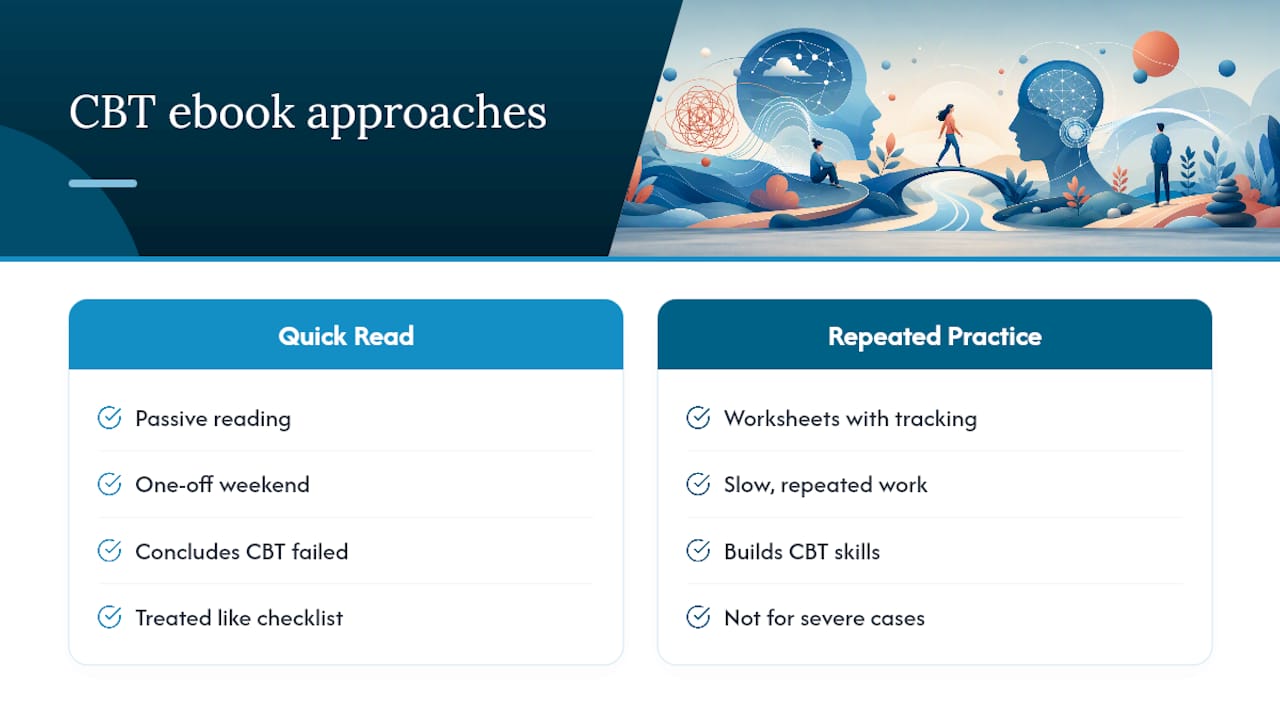
What the evidence actually supports is narrower and more useful: a workbook built on real cognitive and behavioral techniques, worked through slowly with tracking, helps most people build skill. It’s not a replacement for a clinician when symptoms are severe, and it’s not useless when they’re not. The mistake I see most often isn’t picking the wrong ebook. It’s picking the right one and reading it like a paperback instead of a practice tool. Slow down, do the worksheet, and revisit sections you didn’t fully absorb before moving on.
Where To Find Ebook-warehouse’s Cbt-related Workbooks
If the free resources above got you comfortable with the format, Ebook-warehouse carries downloadable workbooks built for the next stage: sustained, disorder-focused practice you can return to for months, not just a weekend.

Anxiety and Depression 101 fits readers who want structured self-study tied directly to mood and anxiety patterns. Developing Emotional Intelligence fits readers building emotional regulation skills that pair naturally with standard CBT exercises. Every title ships as a downloadable PDF or EPUB, so it reads the same on a laptop, tablet, or phone, and each purchase is yours to revisit across devices rather than locked to one app.
Browse the full self-help ebook collection to compare titles by goal, then pick the workbook that matches where you actually are right now, not where you think you should be.
Sources
- Cognitive Behavior Therapy - StatPearls - NCBI Bookshelf
- Cognitive-Behavioral Therapy, Second Edition — APA
- CBT worksheets, handouts and skills-development — Psychology Tools
- Psychotherapies — National Institute of Mental Health (NIMH)
Recommended
- Free Stoicism Ebooks: Best Sources and What to Read First – eBook Warehouse
- The Best Freelancing Ebooks: Practical Picks to Read and Use – eBook Warehouse
- Best Meditation Ebooks for Beginners to Advanced in 2026 – eBook Warehouse
- Best Emotional Intelligence Ebooks to Download Right Now – eBook Warehouse