

The Best Marketing Strategy Ebooks to Download Right Now
The best marketing strategy ebooks right now are eBook Warehouse’s Business Growth Bundle for owners who need a full playbook, LinkedIn Business Essentials for B2B social selling, and The Blogging Marketing Workbook for content-first teams. All three download instantly as PDFs, work across devices, and pair well with free resources from HubSpot and DigitalMarketer for tactical depth. Start with one strategic title and one channel-specific title, then build from there.
TL;DR:
- Choose recent ebooks that include templates, real examples, and are aligned with your current skill level and channel focus.
- Prioritize short, tactical titles with practical worksheets for quick application, reserving longer texts for foundational understanding.
- Test each chapter with immediate implementation, like creating a content calendar or campaign brief, to turn theory into actionable campaigns.
- Avoid relying on outdated tactics by verifying platform features and algorithm references within two years of publication.
- Build a modular library with niche, purpose-driven ebooks rather than one comprehensive textbook to stay adaptable to shifting marketing channels.
Table of Contents
- Marketing Strategy Ebooks Worth Downloading, By Category
- What Each Ebook Category Actually Delivers
- How to Pick the Right Marketing Strategy Ebook
- Why Trust This List: Curation, Author, and Reading Paths
- Turning Ebook Chapters Into Actual Campaigns
- Fitting New Ebook Ideas Into a Plan You Already Run
- Ebooks vs. Videos, Courses, and Blog Posts
- Keeping Ebook Content Current and Relevant
- Checking Author Credibility Before You Buy
- Building a Modular Ebook Library That Actually Gets Used
- Start Building Your Marketing Library Today
- Sources
Marketing Strategy Ebooks Worth Downloading, By Category
Picking from a pile of marketing strategy ebooks without a filter wastes time. The fix is sorting by job function first, then by format, so you grab exactly what solves the problem in front of you this week. Below is a shortlist organized by the work it actually helps you do, not by title popularity.
Core strategy and planning
1. Business Growth Bundle — This eBook Warehouse title is the closest thing to a full marketing curriculum in one purchase. It covers positioning, planning, and channel selection, and fits owners or generalist marketers who need one resource instead of five. Format: paid PDF, instant download, works across phone, tablet, and desktop.
2. Digital Marketing Strategy (Open Textbook Library) — A free, structured, textbook-style overview built for readers who want the academic scaffolding behind digital campaigns rather than quick hacks. It suits people newer to the field or anyone training a junior hire from scratch, and its open-access format means no paywall friction.
3. The Ultimate Guide to Digital Marketing (DigitalMarketer) — Built around the Customer Value Journey framework, this free guide treats digital marketing as a set of core disciplines rather than a grab bag of tactics. It fits heads of growth who need a repeatable model to hand to a team, not just inspiration.
Content marketing and inbound
4. The Blogging Marketing Workbook — A tactical, workbook-style title from eBook Warehouse aimed at content leads and solo founders who write their own copy. It leans on templates over theory, which makes it faster to apply than a general strategy book. Paid PDF, instant access.
5. HubSpot’s Inbound Marketing Strategy Ebooks — HubSpot’s free resources library covers inbound fundamentals with campaign templates and persona worksheets attached. These often pair with webinars or checklists, so you get more than a static PDF for zero cost.
SEO and search
6. SEO Skills and Mastery — eBook Warehouse’s search-focused title targets marketers who own organic growth but have not formally studied technical SEO. It works as a companion to a broader strategy ebook rather than a replacement for one. Paid PDF.
Social and community
7. LinkedIn Business Essentials — Built specifically for B2B marketers running social selling or founder-led outreach on LinkedIn. It fits sales-adjacent marketers more than brand teams, and it is narrow by design, which is exactly the point for a channel-specific download.
8. Audience Building Strategies for Small Business Growth — This community-building resource from PeerFounder addresses the slower, trust-based side of growth that paid ads skip. Useful for founders without an ad budget.
Analytics and measurement
9. Digital Marketing: A Complete Guide (Salesforce) — Salesforce’s guide explains how SEO, content, social, email, and PPC get measured and combined into a single strategy, with attention to attribution. Best read after you have a campaign live, not before.
Paid and conversion optimization
Paid-media ebooks are thinner on the free side of the market. Most credible CRO and PPC guides sit behind paid bundles or platform certifications rather than standalone PDFs, so a strategy ebook that includes a paid-media chapter, like the Business Growth Bundle, tends to be a better buy than hunting for a single-channel paid ebook alone.
Three starter picks if you only grab three: the Business Growth Bundle for owners who need the whole map, the Digital Marketing Strategy open textbook for anyone building foundational knowledge, and The Blogging Marketing Workbook for content leads who want templates over theory.
What Each Ebook Category Actually Delivers
Every category on that shortlist maps to a different business outcome, and choosing by category, not by title buzz, keeps you from buying five books that all cover the same ground.
- Core strategy ebooks build the framework you’ll reuse for every campaign; read these first if you’re a CMO or founder setting direction.
- Content and inbound ebooks drive top-of-funnel awareness and lead generation, best for content leads and solo operators.
- SEO and search guides support long-term organic traffic; a head of growth reads these to reduce paid-ad dependence.
- Social and community titles build retention and word-of-mouth, ideal for B2B marketers and community managers.
- Analytics ebooks close the loop by explaining attribution and measurement, which every role eventually needs once a campaign is live.
Format matters as much as topic. Short, tactical ebooks with templates get used; long theoretical texts get bookmarked and forgotten. Reserve textbook-length reading, like the open-access strategy guide, for when you need comprehensive grounding rather than a checklist for tomorrow’s meeting.
Pro Tip: Pair one long-form strategy ebook with one short, template-heavy ebook per quarter. The first gives you the “why,” the second gives you the “how you’ll actually do it Monday morning.”
How to Pick the Right Marketing Strategy Ebook
A good marketing strategy ebook earns a spot on your shelf by meeting a few concrete criteria, not by having an attractive cover.
Judge each candidate against these:
- Recency — Does it reference current channel behavior, not a 2019 algorithm?
- Skill level match — Is it written for your current role, or one level above it?
- Templates included — Does it hand you a campaign brief or persona worksheet, or just describe one?
- Channel fit — Does it match a channel you actually run?
- Evidence and examples — Does it show real campaigns, or only assert claims?
- Downloadable assets — Can you extract a checklist or template without retyping it?
Run this six-step scan before buying or downloading:
- Check the publish or last-updated date on the product page.
- Skim the table of contents for a template or worksheet appendix.
- Confirm the format (PDF, free vs. paid) matches how you’ll use it.
- Look for at least one named campaign example, not generic claims.
- Read one sample page if available; vague language is a red flag.
- Verify it fits a gap in what you already own, not a duplicate.
Red flags worth walking away from: stats older than two years with no update note, zero real examples, and cover copy promising results with no method behind it.
Why Trust This List: Curation, Author, and Reading Paths
This shortlist comes from cross-referencing what practicing marketers actually use, weighing recency, template quality, and alignment with recognized frameworks like the Customer Value Journey, rather than picking titles by popularity alone.
“The strongest sequence starts with strategy, moves to channel tactics, and ends with measurement, so a reader never learns a tool without also learning why it matters.” That progression, drawn from how DigitalMarketer structures its own guide, is the same order this article follows.
eBook Warehouse curates its marketing catalog the same way: titles get selected for practical templates and instant multi-device PDF delivery, not just topic coverage. Stephen, who covers marketing strategy resources for eBook Warehouse, built this list around what a busy marketer would actually finish reading, not what looks comprehensive on a shelf.
A workable three-book sequence:
- Strategy: Business Growth Bundle or the Digital Marketing Strategy open textbook
- Channel: LinkedIn Business Essentials or The Blogging Marketing Workbook
- Measurement: a Salesforce or DigitalMarketer guide focused on attribution
Turning Ebook Chapters Into Actual Campaigns
An ebook that sits unread on a hard drive delivers nothing. The practical fix is to treat each chapter as a work session, not a reading assignment: finish a chapter, then immediately build the artifact it describes, whether that’s a persona document, a content calendar, or a campaign brief.

Block 30 minutes right after reading to draft the template while the framework is still fresh. Marketers who skip this step tend to reread the same chapter months later because nothing from it made it into an actual document. If an ebook includes a worksheet or checklist, print or copy it into your working files immediately, don’t leave it as a PDF attachment you’ll “get to.”
Test one idea per ebook on a small scale before rolling it out across every channel. A chapter on email segmentation, for example, should produce one test segment and one measured send, not an overhaul of your entire list. That keeps the learning tied to a real result instead of a theory you never validated.
Fitting New Ebook Ideas Into a Plan You Already Run
The mistake most marketers make with a new ebook is trying to bolt its entire framework onto an existing plan overnight. That usually breaks whatever was already working. A better approach: pick one specific tactic or template from the ebook, map it against your current quarterly plan, and swap it in for the weakest existing tactic rather than adding it on top.
Keep a short running document of “ebook ideas to test,” dated and tagged by which book they came from. Review that list monthly, not the day you finish reading, since ideas that still seem worth testing a few weeks later are the ones with real staying power. Ideas that seemed exciting on page one but forgettable by the next review usually aren’t worth the disruption.
When an ebook’s advice conflicts with your current plan, don’t assume the ebook is right by default. Check whether the recommendation matches your audience and channel mix; a tactic built for e-commerce funnels won’t transfer cleanly to a B2B sales cycle just because it worked in the book’s case study.
Ebooks vs. Videos, Courses, and Blog Posts
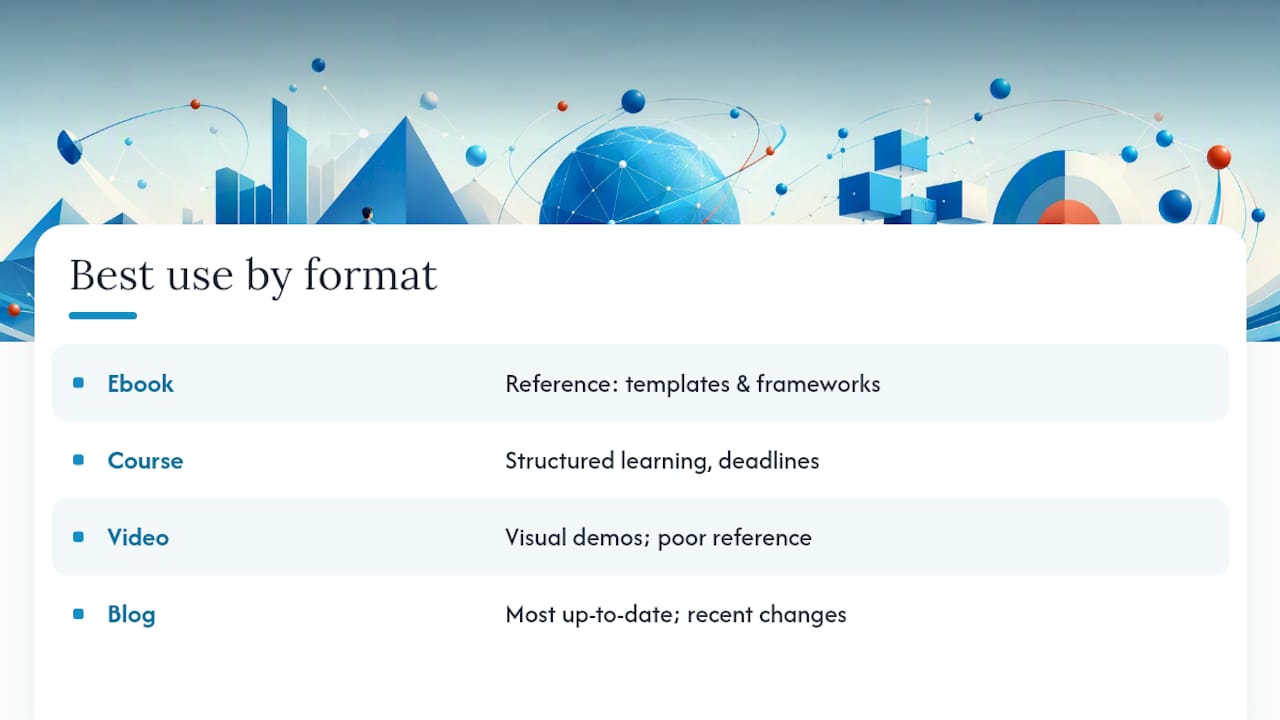
Ebooks earn their place for one reason video and blog content usually can’t match: depth you control the pace of. You can skim, reread a page, and extract a template without scrubbing through a timeline. Courses offer structured accountability and sometimes live feedback, which ebooks lack entirely; if you need deadlines to finish something, a course beats a PDF sitting in a downloads folder.
Blog posts win on recency. A blog can reflect this week’s algorithm change; an ebook, even a good one, reflects the moment it was written. That’s exactly why shorter, templated ebooks tend to age better than long theoretical ones, and why practitioners often treat ebooks as reference material to revisit rather than one-time reads.
Video works best for demonstrating a skill visually, like screen-recording an ad-account setup, something no ebook does well. But video is poor for reference; nobody rewatches a 40-minute webinar to find one framework slide. The practical answer isn’t choosing one format permanently. It’s matching format to task: an ebook for frameworks and templates you’ll return to, a course for structured skill-building with deadlines, video for visual walkthroughs, and blogs for what changed this month.
Keeping Ebook Content Current and Relevant
Marketing platforms change faster than most publishing schedules, which means an ebook’s tactical chapters age out long before its strategic chapters do. Check the publish date or last-revised note on any ebook’s product page before you buy, and treat anything referencing platform features or algorithm behavior from more than two years back as directional only, not a step-by-step guide.
Framework-level content, like a positioning model or a customer journey map, holds up far longer than a chapter on a specific ad platform’s targeting options. When evaluating an ebook’s currency, separate the two: trust the framework, verify the tactics against a current source before acting on them.
eBook Warehouse addresses this by favoring shorter, focused titles that get revised or replaced faster than a 300-page textbook could be. A niche ebook on one channel is easier to swap out for an updated edition than a sprawling guide covering ten topics at once, which is part of why modular libraries tend to stay more current than single giant reference books.
Checking Author Credibility Before You Buy
The name on the cover matters more than most buyers realize. Before downloading a paid marketing strategy ebook, check whether the author has a visible track record: a named agency, a documented client list, or a body of published work you can verify independently, not just a bio claiming “years of experience.”
Look for specificity in the ebook itself. An author who names real campaign examples, cites actual metrics, and references recognizable frameworks, like the Customer Value Journey or established attribution models, is easier to trust than one who deals only in generalities. Vague promises with no methodology behind them are the clearest warning sign of an ebook written for volume rather than value.
Publisher reputation matters too. A curated catalog from a source that vets titles for practical templates and current examples carries more weight than a random self-published PDF with no editorial process behind it. That’s the standard eBook Warehouse applies to its own marketing titles: each one gets selected for applicability, not just topic coverage, before it’s added to the catalog.
Building a Modular Ebook Library That Actually Gets Used
The all-in-one marketing textbook sounds efficient, but a smaller library of replaceable, niche ebooks (technical SEO one quarter, LinkedIn outreach the next) tends to serve working marketers better because platforms shift faster than any single book gets revised. That’s the case for treating your ebook shelf as a living library, not a fixed curriculum.
My own workflow: pick one strategic ebook and one tactical ebook, run both against a real campaign for 30 days, then keep what worked and swap out what didn’t. This isn’t about finishing every book cover to cover. It’s about testing ideas fast and rotating in fresh, focused titles as your channel mix changes.
— Stephen
Start Building Your Marketing Library Today
Ebook Warehouse’s catalog gives you something a scattered mix of free PDFs and paid courses rarely does: curated, role-specific titles you can download instantly and read on any device, without hunting across a dozen sites for the one chapter you actually need.
For owners who want a complete strategic foundation in one purchase, the Business Growth Bundle covers planning, positioning, and channel selection without requiring five separate downloads. If your priority is B2B growth specifically, LinkedIn Business Essentials delivers tactical, channel-specific guidance for social selling and outreach. Both are instant PDF downloads, readable across phone, tablet, and desktop, and both fit the modular approach this article recommends: pick the title that matches your immediate gap, not the one with the biggest page count. Visit the Business Growth Bundle page now to see what’s inside and start your first 30-day reading test this week.
Sources
A few resources worth bookmarking alongside your ebook downloads:
- Digital Marketing: A Complete Guide | Salesforce
- Inbound Marketing Strategy Ebooks - HubSpot Free Resources Library
- The Ultimate Guide to Digital Marketing | DigitalMarketer
- Digital Marketing Strategy - Open Textbook Library