

Project Management Ebooks for Learners: Free Picks and a Study Plan
The best places to read or download project management ebooks right now are the Open Textbook Library, PM4DEV, university library guides, and PMI for standards reference. Each gives you something different, and knowing which one to open first saves hours of aimless searching.
If you want a complete, structured textbook with zero cost, start with the Open Textbook Library. If you need practical templates for real-world project work, PM4DEV fills that gap. If you’re studying for a certification, you’ll eventually need the PMBOK® Guide from PMI, even if you build your foundation elsewhere first.
- Open Textbook Library: full open-license textbook covering the entire project lifecycle, free to read online or download as PDF.
- PM4DEV: free ebooks and templates built for practitioners running development-sector projects.
- University library guides: aggregated ebook and database access, including O’Reilly collections, often requiring institutional login.
- James Cook University Pressbooks: a downloadable, Creative Commons licensed strategic project management text.
- PMI: the PMBOK® Guide, the standard reference for certification study and professional frameworks.
- eBook Warehouse: a paid fallback if you’d rather buy one curated, ready-to-use ebook than assemble free sources yourself.
The fastest path to a working project management education costs nothing. The fastest path to a convenient one might cost a few dollars.
Key Takeaways
Project management ebooks work best when free foundational sources are paired with a structured study plan and, where certification is the goal, PMI’s standards reference.
| Point | Details |
|---|---|
| Start with open textbooks | Read the Open Textbook Library’s full project management text before buying anything. |
| Match the book to your goal | Use PMBOK for certification, The Phoenix Project or Scrum for practical/Agile insight. |
| Apply a study structure | Follow a six to eight week plan pairing chapters with real practice projects or templates. |
| Verify licenses before downloading | Confirm Creative Commons terms or institutional access before trusting a “free” PDF source. |
| Consider a curated store for convenience | Ebook-warehouse offers a single-source paid option for readers who want packaged, ready-to-use ebooks. |
Table of Contents
- Must-Read Project Management Ebooks by Goal
- How Do You Pick the Right Ebook for Your Goal?
- Formats, Licensing, and Safe Downloads Explained
- Turning Ebooks Into an Actual Study Plan
- Free Extras That Make Ebooks More Useful
- Why Curated Ebook Collections Still Matter
- A Faster Way to Build Your Project Management Library
- Frequently Asked Questions
- Sources
Must-Read Project Management Ebooks by Goal
Not every ebook belongs on every reading list. The right pick depends entirely on whether you’re building fundamentals, studying for a credential, or trying to fix how your team actually ships work. Here’s a shortlist organized by what each book is actually good for.
- Project Management (Adrienne Watt), beginner: the open textbook covering the full lifecycle from initiation through closeout. Start here if you’ve never studied project management formally.
- PMBOK® Guide, exam prep and standards reference: PMI’s recognized global standard describes six core principles and seven performance domains, and its latest edition adds coverage of AI and PMO functions. This isn’t light reading, but it’s the vocabulary and framework certification exams are built around.
- Project Management Absolute Beginner’s Guide (Greg Horine), beginner: a plain-language walkthrough aimed at people with zero project management background, often recommended alongside PMBOK as a gentler entry point before tackling the standard itself.
- The Phoenix Project (Gene Kim, Kevin Behr, George Spafford), industry-specific: told as a business novel rather than a manual, this one teaches IT and DevOps project dynamics through story instead of framework. It sticks with readers precisely because it doesn’t read like a textbook.
- Scrum: The Art of Doing Twice the Work in Half the Time (Jeff Sutherland and JJ Sutherland), Agile/intermediate: written by one of Scrum’s co-creators, this book explains the reasoning behind Agile sprints rather than just the mechanics, which makes it useful even if your team already uses Scrum loosely.
- Managing Agile Projects (Scott Ambler), intermediate to industry-specific: focuses on techniques that work across Agile methods rather than locking you into one framework, which matters if your projects have unclear requirements or shift direction often.
Coursera’s own roundup of beginner project management books makes a similar point: the right book depends on whether you’re chasing an overview, an Agile foundation, or exam readiness, and mixing all three into one reading list usually backfires. Cross-method books like Ambler’s tend to hold up longer than titles locked to a single methodology, because your role and your organization’s process will likely change before your understanding of project management does.
If you only have time for one book beyond the free textbook, make it PMBOK if you’re pursuing certification, or The Phoenix Project if you just want to understand why projects actually fail in practice.
How Do You Pick the Right Ebook for Your Goal?
Before downloading anything, run through this quick checklist:
- Define your goal. Are you learning fundamentals from scratch, studying for a specific certification, or solving a problem your current projects have right now?
- Assess your starting point. If you’ve never touched a Gantt chart, skip straight to the PMBOK glossary and you’ll drown. Start with a beginner text instead.
- Pick your format preference. Some people retain more from a structured textbook; others learn faster from narrative books like The Phoenix Project.
- Check whether you need practice tools. Certification prep requires practice questions and templates, not just theory. A pure reading list won’t get you exam-ready alone.
Watch for these red flags before committing time to any ebook:
- Outdated editions. Project management practice shifts, especially around Agile and hybrid methods, so a ten-year-old edition may describe processes your workplace no longer follows.
- Unclear licensing. If a “free” PDF doesn’t state its license or source, you can’t verify it’s legal to redistribute or even accurate.
- No table of contents or sample chapter available. If a source won’t show you what’s inside before you download, that’s reason enough to look elsewhere.
Match the book type to the job: theory and frameworks (PMBOK, the Watt textbook) build your vocabulary and structure. Hands-on implementation guides (PM4DEV, Ambler) teach you what to actually do on Monday morning. Exam-prep material fills the narrow gap between understanding concepts and passing a timed test. Rarely does one book do all three well.
Formats, Licensing, and Safe Downloads Explained
PDF works everywhere and is the default for most open textbooks and library-hosted material. ePub fits e-readers better but shows up less often in this category. Online viewers let you preview before downloading, which is worth doing before committing to a 300-page file.
License terms matter more than most readers realize. CC BY lets you read, share, and adapt content freely as long as you credit the source. CC BY-SA adds a requirement that adaptations carry the same license forward. CC BY-NC permits sharing and adapting but blocks commercial use. Most academic open textbooks, including the Open Textbook Library’s project management title, use one of these Creative Commons variants.
Library and database access adds another layer: platforms like O’Reilly typically require an active institutional login, meaning the ebook itself isn’t technically free, your school or employer already paid for access on your behalf. And a safety note worth taking seriously: avoid downloading PDFs from unfamiliar file-sharing sites promising “free” copies of copyrighted books like PMBOK. Stick to the publisher, PMI’s own site, or verified library portals.
Turning Ebooks Into an Actual Study Plan
Reading a project management ebook cover to cover doesn’t automatically produce project management skills. You need a plan that forces you to apply what you’re reading, and a six to eight week structure works well for most beginners with a day job.
- Weeks 1 to 2: Read the initiation and planning chapters of the Open Textbook Library’s project management text. Annotate as you go, don’t just highlight.
- Weeks 3 to 4: Move into scheduling, resource management, and budgeting chapters. Build one real (or hypothetical) project schedule using the frameworks you just read.
- Week 5: Read PMBOK’s core principles and performance domains if certification is your goal. Otherwise, substitute Managing Agile Projects if your work involves Agile or hybrid teams.
- Week 6: Work through risk and quality management chapters, then pull a PM4DEV template and apply it to a real scenario, even a small one.
- Weeks 7 to 8: Take practice questions if you’re exam-bound, or read The Phoenix Project or the Scrum book if you’re building intuition for how teams actually operate under pressure.
A few tactics make this stick better than passive reading. Annotate chapters instead of highlighting them; the act of writing forces retrieval. Space out review sessions rather than cramming, since spaced repetition consistently beats marathon reading. And build one real practice project alongside your reading, even something small like planning a home renovation, because applying a framework to a real decision teaches you more than three more chapters would.
Pro Tip: Pair every theory chapter with one practice question or template application before moving to the next chapter. Practitioners who study this way tend to retain frameworks longer than those who read straight through and test themselves only at the end.
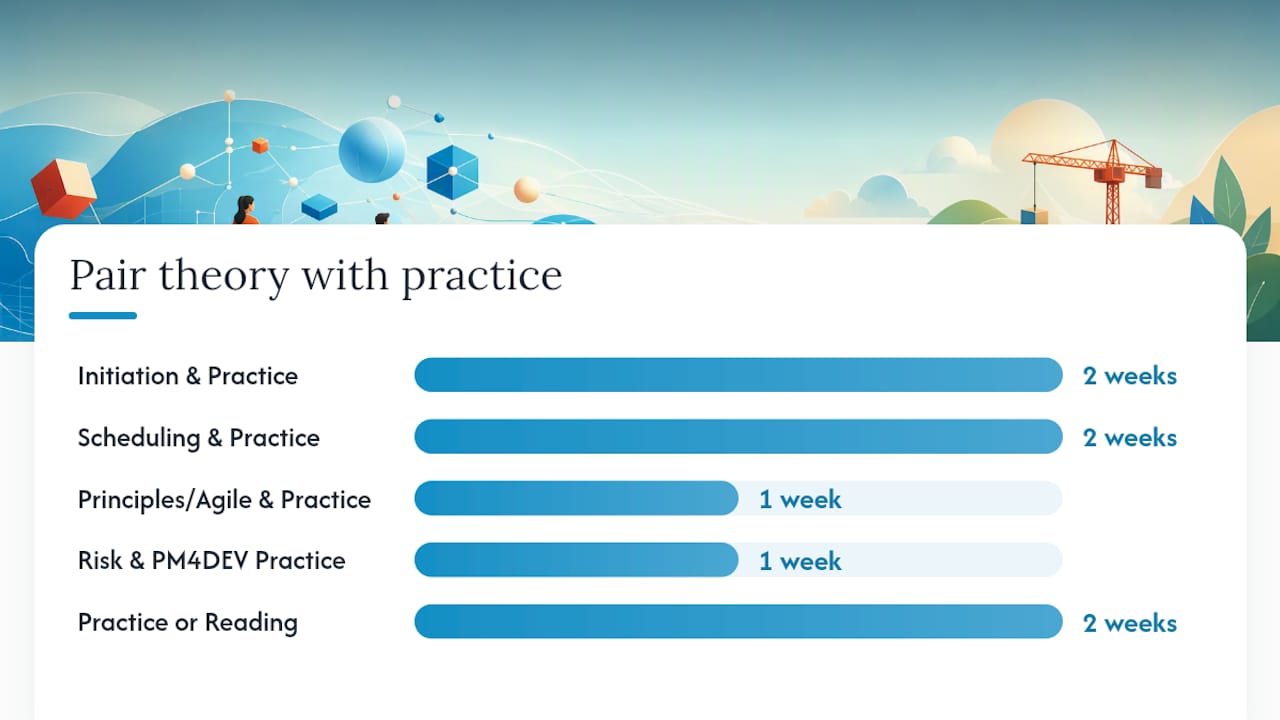
Pairing ebooks with practice exams, checklists, and templates closes the gap between “I understand this concept” and “I can apply this under exam or deadline pressure.”
Free Extras That Make Ebooks More Useful
A handful of quick add-ons turn passive reading into working knowledge without adding a second full ebook to your list.
- PM4DEV templates: ready-made project charters, risk registers, and stakeholder maps you can adapt immediately.
- University library cheat sheets: condensed reference guides, often bundled alongside the ebooks in library guide portals.
- Short video playlists or MOOCs: useful for visual learners who want a walkthrough of a concept before reading the textbook chapter on it.
- Practice question banks: essential if you’re pursuing PMP or CAPM certification, since PMBOK alone won’t simulate exam conditions.
Why Curated Ebook Collections Still Matter
Free resources are genuinely excellent, and nothing in this article suggests otherwise. But assembling four different sources, checking licenses, and verifying editions takes real time most learners don’t have.

A curated collection removes that friction: someone has already checked formats, confirmed the content is current, and packaged it for immediate use. That’s the entire value proposition behind a curated ebook selection built around a specific goal rather than a scattered reading list assembled from five different websites.
A Faster Way to Build Your Project Management Library
If you’ve read this far, you already know the free ebook landscape works, but it takes work to navigate: checking licenses, verifying editions, and hopping between library portals and open textbook sites. Ebook-warehouse takes a different approach for readers who’d rather spend that time studying instead of searching.
Ebook-warehouse curates downloadable PDF ebooks across business, personal development, and productivity categories, including titles built around practical skill-building rather than academic theory alone. Every purchase comes formatted consistently and works across your devices immediately after checkout, no hunting for the right edition or confirming a license lets you actually use what you downloaded. Browse the personal productivity collection if you want practical, ready-to-apply material to pair with the free lifecycle textbooks covered above, or check out Maximise Your Earnings if your project management goals tie into building a business on the side.
Frequently Asked Questions
Are project management ebooks actually free anywhere reputable? Yes. The Open Textbook Library and PM4DEV both offer complete, legally free ebooks with no hidden paywall, and university-published texts like James Cook University’s strategic approach ebook carry open Creative Commons licenses.
Do I need the PMBOK Guide if I’m not pursuing certification? Not necessarily. PMBOK is the standard reference for certification study, but if you’re learning project management for general work skills, a beginner textbook or a practical book like The Phoenix Project may serve you better first.
What’s the difference between an open textbook and a library-hosted ebook? An open textbook, like the Open Textbook Library’s project management title, is freely licensed and downloadable by anyone. A library-hosted ebook, such as those accessed through O’Reilly, usually requires an active institutional login because your school or employer has already paid for the subscription.
How long does it take to learn project management basics from ebooks alone? A focused six to eight week plan, reading roughly one to two chapters weekly alongside a small practice project, gives most beginners a working foundation. Certification prep on top of that typically adds several more weeks of practice testing.
Should I read an Agile-specific book if my job doesn’t use Agile yet? It’s still worth it. Books like Scrum: The Art of Doing Twice the Work in Half the Time explain reasoning that applies beyond formal Scrum teams, and Agile practices are increasingly blended into traditional project environments anyway.
Sources
Free doesn’t mean low quality here. Some of the strongest introductory material in this field lives behind no paywall at all, and the four sources below are where serious self-learners actually go.
Open Textbook Library hosts a full-length project management textbook built from Adrienne Watt’s original work and later adaptations. It runs through initiation, planning, scheduling, resource and budget management, procurement, quality, risk, communication, and project closeout, essentially the entire lifecycle in one open-license volume. The book is free to read online or download as a PDF, and many versions include appendices and instructor materials like slide decks and chapter questions, which speeds up self-study planning if you’re teaching yourself without a classroom.
PM4DEV takes a different angle. Instead of academic chapters, PM4DEV’s ebooks focus on applied guidance for practitioners working in development and nonprofit-style project environments. You’ll find templates alongside the text, which matters if your goal is doing project work rather than passing an exam. The tradeoff is scope: PM4DEV is practical and narrow, not a comprehensive lifecycle reference.
University library guides solve a different problem: access to paid content without paying for it yourself. Guides like the one from Florida Tech’s library aggregate ebooks, databases, and vendor portals such as O’Reilly’s collection, alongside links to PMBOK releases and PMP/CAPM prep guides. If you have any active student or alumni credentials, this route can unlock content that would otherwise sit behind a subscription. Check your institutional access before assuming you need to pay for anything.
Pressbooks and Creative Commons texts round out the free tier. James Cook University publishes Project Management: A Strategic Approach as a downloadable PDF under a Creative Commons license, organized into modules with key takeaways and references. It’s a good example of how instructors assemble openly licensed chapters into course-ready material, which means you’re not just getting a book. You’re getting something closer to a self-paced course.
A few format notes worth knowing before you start clicking download links:
- PMBOK Guide | Project Management Institute
- 12 Project Management Books for Beginners | Coursera
- Managing Agile Projects - Agile Project Management