

Top 10 Resilience Ebooks to Download and Read Now
The best resilience ebooks available right now include the Ebook-warehouse Resilience Collection, Option B by Sheryl Sandberg and Adam Grant, Grit by Angela Duckworth, Rising Strong by Brené Brown, Emotional Agility by Susan David, Man’s Search for Meaning by Viktor Frankl, Resilience by Andrew Zolli and Ann Marie Healy, Resilience: The Science of Mastering Life’s Greatest Challenges by Steven M. Southwick and Dennis S. Charney, The Stress Prescription by Elissa Epel, and Full Catastrophe Living by Jon Kabat-Zinn. Every title is available in ebook format, most through major U.S. platforms like Amazon Kindle, Apple Books, and Google Play Books, and several as instant PDF downloads directly from Ebook-warehouse.
What makes these picks worth your time:
- Evidence-based practices: MBSR, CBT-informed cognitive reframing, and neuroplasticity-grounded habit work
- Mindset and meaning: memoir-driven titles that reframe adversity rather than just manage it
- Habit-focused guides: structured programs with worksheets and day-by-day exercises you can start immediately
- Instant access: Ebook-warehouse offers PDF downloads readable on any device, no subscription required
If you want one place to start, the Ebook-warehouse Resilience Collection gives you curated personal development titles in a single download, no waiting, no shipping.
Key Takeaways
The most effective way to build resilience through reading is to match the book to your weakest skill area, choose a title with practical exercises, and start a single technique within 24 hours of finishing the first chapter.
| Point | Details |
|---|---|
| Match book to your goal | Skills training, cognitive reframing, and meaning-making each call for a different type of title. |
| Prioritize practical exercises | Titles with worksheets, scripts, or day-by-day programs produce more behavior change than narrative-only books. |
| Evidence base matters | Look for MBSR, CBT, ACT, or neuroplasticity grounding and credentialed authors (clinical, academic, or practitioner). |
| Start one technique immediately | Third-person self-talk, a five-minute MBSR breath practice, or stress-cycle completion can be tried in under ten minutes. |
| Ebook-warehouse for instant access | PDF downloads from Ebook-warehouse are readable on any device with no subscription, making it the fastest way to start. |
Table of Contents
- The best resilience ebooks you can download right now
- How to choose the right resilience ebook for your needs
- Evidence-based resilience strategies you’ll find in these ebooks
- What most resilience reading lists get wrong
- Ebook-warehouse makes starting your resilience reading easy
- Sources
The best resilience ebooks you can download right now
These ten picks cover the full range of what “building resilience” actually means in practice: clinical frameworks, memoir-driven reframing, habit science, and meaning-making. Each entry notes who it helps most, format availability, approximate price, read time, and whether it includes practical exercises.
1. Ebook-warehouse Resilience Collection
Best for: Readers who want a curated starting point without hunting across multiple stores. Format: PDF (instant download) Price range: Varies by title; bundle discounts available Read time: Varies by selection Practical exercises: Yes, depending on titles included
Ebook-warehouse curates personal development ebooks across health, wellness, and mindset categories, all available as instant PDF downloads. The collection is readable on any device, phone, tablet, laptop, or e-reader, without a subscription. For readers who want to skip the browsing and get straight to building skills, this is the most frictionless starting point on the list. Check the best self-help ebooks editorial for related picks.
2. Option B — Sheryl Sandberg and Adam Grant
Best for: Anyone processing grief, loss, or a major life disruption. Format: Ebook, audiobook Price range: ~$13–$15 Read time: 5–6 hours Practical exercises: Yes, reflection prompts and community-building strategies
Sandberg wrote this after her husband’s sudden death, and Grant brought the research. The combination is unusual: raw personal narrative woven through psychological science on post-traumatic growth. Therapist and coaching roundups consistently include it as one of the most recommended bounce-back books, and for good reason. The exercises focus on rebuilding meaning and social connection, two of the most evidence-supported levers for recovery.
3. Grit — Angela Duckworth
Best for: Readers who want to understand why persistence matters more than talent. Format: Ebook, audiobook Price range: ~$13–$15 Read time: 6–7 hours Practical exercises: Yes, self-assessment tools and deliberate practice frameworks
Duckworth’s research at the University of Pennsylvania showed that grit, the combination of passion and perseverance, predicts long-term success better than IQ in most domains she studied. The ebook version includes her self-assessment scale, which you can complete in under ten minutes. Readers who feel stuck after repeated setbacks tend to find this one reframes the problem entirely.
4. Rising Strong — Brené Brown
Best for: Readers who want a structured process for getting back up after failure or shame. Format: Ebook, audiobook Price range: ~$13–$15 Read time: 6–7 hours Practical exercises: Yes, journaling prompts and the “reckoning, rumble, revolution” framework
Brown’s three-step process for emotional recovery is one of the more practical frameworks in the resilience self-help space. It is not just memoir; each chapter closes with concrete reflection work. Roundups of resilience books place it alongside Option B as a go-to for emotional strength building, and the ebook format makes it easy to return to specific chapters when you need them.
5. Emotional Agility — Susan David
Best for: Readers dealing with chronic stress, perfectionism, or emotional avoidance. Format: Ebook, audiobook Price range: ~$12–$14 Read time: 5–6 hours Practical exercises: Yes, “unhooking” exercises and values-clarification tools
David, a Harvard Medical School psychologist, argues that the problem is not negative emotions but our rigid relationship with them. The ebook includes practical “unhooking” techniques, short exercises that create distance between a feeling and a reaction. This is one of the few stress management ebooks that draws directly on Acceptance and Commitment Therapy (ACT) without requiring any clinical background to follow.

6. Man’s Search for Meaning — Viktor Frankl
Best for: Readers facing profound adversity or existential questions about suffering. Format: Ebook, audiobook Price range: ~$9–$12 Read time: 3–4 hours Practical exercises: Reflection questions; the second half introduces logotherapy principles
Short, dense, and unlike anything else on this list. Frankl’s account of survival in Nazi concentration camps and his development of logotherapy, the idea that meaning is the primary human motivator, has influenced clinical psychology for decades. At roughly 200 pages, it is the fastest read here and often the most lasting. No worksheets, but the questions it raises tend to do the work.
7. Resilience — Andrew Zolli and Ann Marie Healy
Best for: Readers who want a systems-level view of how resilience works across individuals, communities, and organizations. Format: Ebook, audiobook Price range: ~$12–$14 Read time: 7–8 hours Practical exercises: Limited; this is primarily analytical
Zolli and Healy pull from ecology, urban planning, neuroscience, and business to build a cross-disciplinary picture of what makes systems bounce back. It is the most intellectually ambitious title on the list. Readers who want to understand resilience as a concept, not just practice it, will find this one genuinely surprising.
8. Resilience: The Science of Mastering Life’s Greatest Challenges — Steven M. Southwick and Dennis S. Charney
Best for: Readers who want clinical depth and research-backed strategies. Format: Ebook, audiobook Price range: ~$13–$16 Read time: 6–7 hours Practical exercises: Yes, structured resilience factors and self-assessment prompts
Southwick (Yale School of Medicine) and Charney (Icahn School of Medicine at Mount Sinai) interviewed hundreds of trauma survivors and synthesized decades of research into ten resilience factors. This is the most clinically grounded mental resilience book on the list. Evidence-based frameworks like MBSR and neuroplasticity training appear throughout, making it a strong complement to therapy or coaching.
9. The Stress Prescription — Elissa Epel, PhD
Best for: Readers who want a short, structured program they can start this week. Format: Ebook, audiobook Price range: ~$13–$15 Read time: 4–5 hours Practical exercises: Yes, a seven-day science-backed plan with daily exercises and mindset shifts
Epel, a UCSF stress researcher, designed this as a practical intervention, not a theory book. Each of the seven days targets a specific stress response with a short exercise, typically 5–15 minutes. It is the most immediately usable title here for someone who wants to feel different by next week. The ebook format works especially well because you can bookmark each day’s practice.
10. Full Catastrophe Living — Jon Kabat-Zinn
Best for: Readers who want the foundational MBSR program in book form. Format: Ebook, audiobook Price range: ~$14–$17 Read time: 10–12 hours Practical exercises: Yes, full MBSR program with guided meditations referenced throughout
Kabat-Zinn developed Mindfulness-Based Stress Reduction at the University of Massachusetts Medical School, and this book is the closest thing to taking the program without enrolling in a clinic. Therapist-recommended roundups consistently flag it as a foundational text for both self-guided and clinical resilience training. It is the longest read on the list, but the depth is proportional.
Free option: The Growing Resilience e-book from the Growing Resilience Ohio nonprofit project is freely downloadable and covers community-based resilience practices, a useful supplement for readers on a tight budget.
How to choose the right resilience ebook for your needs
Start with your primary goal. That single question narrows the list faster than any other filter.
Skills training: If you want concrete techniques to practice, prioritize books with worksheets, guided exercises, or day-by-day programs. The Stress Prescription, Full Catastrophe Living, and Emotional Agility all deliver this. Look for ebooks that include scripts, guided practices, or session-ready exercises, features that therapist-curated roundups consistently flag as the most useful for real behavior change.
Cognitive reframing and meaning-making: If the problem is how you think about adversity rather than what to do about it, Man’s Search for Meaning, Rising Strong, and Option B are the right tier. These are memoir-informed and less exercise-heavy, but the reframing they offer tends to be durable.
Clinical depth: For readers who want research and evidence over narrative, Resilience by Southwick and Charney and Resilience by Zolli and Healy are the strongest picks. Both draw on peer-reviewed research and are frequently cited in clinical contexts.
Evidence base to look for: The most credible mental resilience books ground their recommendations in MBSR, CBT, ACT, or neuroplasticity research. Author credentials matter too: a clinical psychologist, a research scientist, or a therapist with published peer-reviewed work is a stronger signal than a general wellness coach.
Red flags: Skip any ebook that promises resilience in 24 hours, lacks author credentials, or offers only motivational content with no practical exercises when you specifically need skill-building. Price alone tells you nothing; some of the most useful titles here cost under $10.
Read time and format: Ebooks average 200–300 pages for this genre, which translates to roughly 4–8 hours of reading. If you commute, an audiobook version of the same title lets you cover the same ground. Most of these titles are available in both formats on Kindle, Apple Books, and Google Play Books.
How these picks were selected: Each title was evaluated against four criteria: alignment with evidence-based frameworks (MBSR, CBT, ACT, neuroplasticity), presence of practical exercises or structured programs, author credentials (academic, clinical, or practitioner), and availability in ebook format for instant download in the U.S.
Evidence-based resilience strategies you’ll find in these ebooks
The techniques below appear across multiple titles on this list. Each one has a research foundation and a practice you can try in under ten minutes.
1. Mindfulness-Based Stress Reduction (MBSR) Developed by Jon Kabat-Zinn, MBSR trains attention through body scans, breath awareness, and mindful movement. Authoritative summaries consistently recommend MBSR and neuroplasticity-informed training as among the most effective frameworks for lasting mental health improvement. Try it now: Set a timer for five minutes. Sit still, close your eyes, and focus only on the physical sensation of breathing. When your mind wanders, return to the breath without judgment. That is the core practice.
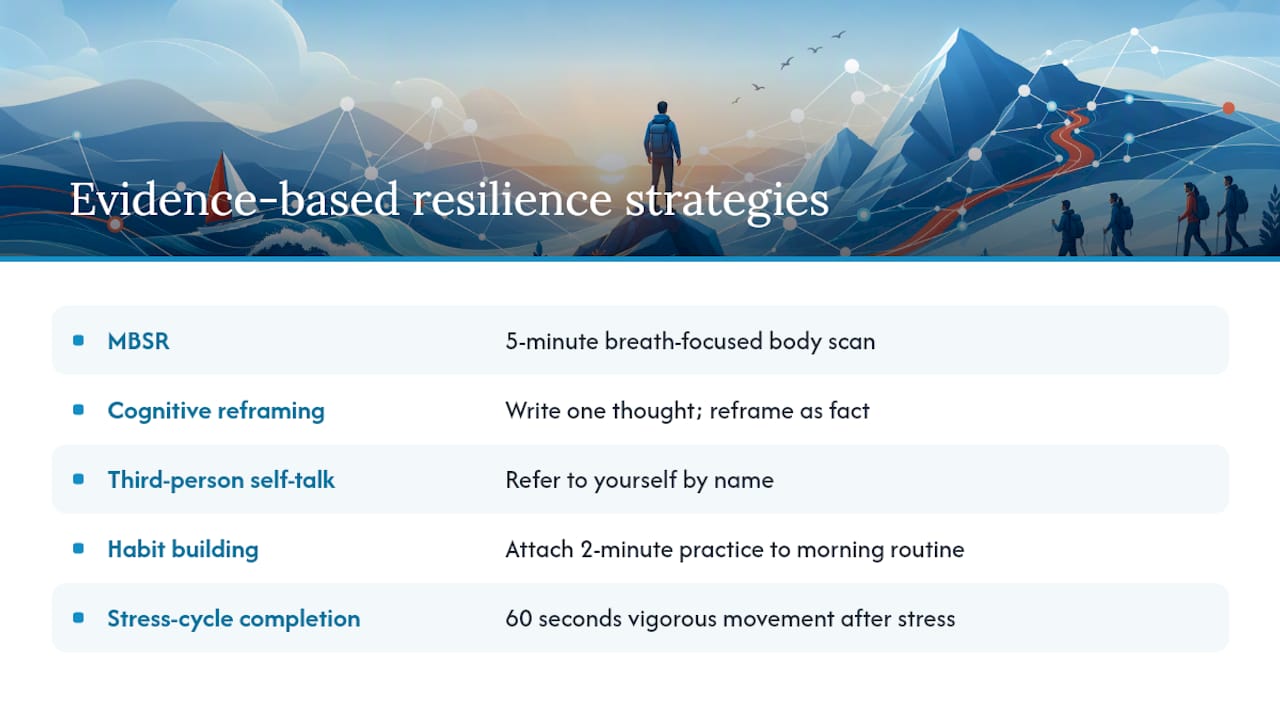
2. Cognitive reframing (CBT-informed) CBT teaches you to identify distorted thought patterns and replace them with more accurate ones. Rising Strong and Emotional Agility both use this framework without requiring clinical knowledge. Try it now: Write down one stressful thought you’ve had today. Then ask: “Is this thought a fact, or an interpretation?” Most are interpretations. Writing the factual version often reduces the emotional charge immediately.
3. Third-person self-talk Research highlighted by experts including Dr. Ethan Kross shows that referring to yourself by name during stressful self-talk (“What should Sarah do here?” instead of “What should I do?”) creates psychological distance that reduces distress. Try it now: The next time you feel anxious before a difficult conversation, narrate the situation in third person using your own name. Most people notice a shift in emotional intensity within a few sentences.
4. Neuroplasticity-informed habit building Grit and Resilience by Southwick and Charney both draw on the brain’s capacity to rewire through deliberate practice. Small, consistent actions build new neural pathways over time. Try it now: Pick one two-minute resilience practice (a gratitude note, a breathing exercise, a brief walk) and attach it to something you already do every morning. Habit stacking is one of the most reliable ways to make a new behavior stick.
5. Stress-cycle completion Chronic stress accumulates when the body’s stress response never fully discharges. The Stress Prescription addresses this directly with short physical exercises designed to complete the biological stress cycle. Try it now: After a stressful event, do 60 seconds of vigorous physical movement, jumping jacks, a brisk walk, or even shaking your hands. The physical discharge signals to your nervous system that the threat has passed.

What most resilience reading lists get wrong
The standard advice is to pick the most popular title and read it cover to cover. That approach works for some readers and fails most of them.
The problem is that resilience is not a single skill. It is a cluster of capacities: emotional regulation, cognitive flexibility, social connection, meaning-making, and physical self-care. A book that excels at one of those rarely covers all five. Man’s Search for Meaning is extraordinary on meaning but offers almost nothing on the physical side. Full Catastrophe Living is deep on mindfulness but light on cognitive reframing. Reading one book and expecting a complete toolkit is like buying one piece of gym equipment and wondering why you’re not fit.
The more useful approach is to identify your weakest link first. If you tend to catastrophize, start with a CBT-informed title like Emotional Agility. If you feel physically wired and can’t wind down, The Stress Prescription addresses the body first. If the problem is meaning, start with Frankl.
Pro Tip: After finishing a chapter, write one sentence: “The one thing I will do differently this week is ___.” Then set a phone reminder for three days later to check whether you did it. That two-step loop, read and commit, then review, converts a book into a seven-day micro-practice without requiring any extra time.
The other thing most lists miss: format matters more than people admit. An ebook you can annotate and bookmark on your phone is more useful than a hardcover sitting on a shelf. The emotional intelligence ebooks and mindset ebooks at Ebook-warehouse are built for exactly this kind of active, annotated reading.
Ebook-warehouse makes starting your resilience reading easy
If you’ve read this far, you already know which type of resilience ebook fits your situation. The next step is actually downloading one and opening it today, not next week.

Ebook-warehouse offers instant PDF downloads across personal development, health, wellness, and mindset categories, all readable on any device without a subscription or platform lock-in. Titles like The Art of Positive Thinking and Healing Inside Out and Outside In complement the resilience reading list above with practical mindset and wellness exercises you can work through alongside the bigger titles. For readers building a broader personal development library, the personal productivity collection pairs well with habit-focused resilience work.
Browse the Ebook-warehouse collection at Ebook-warehouse and download your first title in under two minutes.
Sources
The claims and recommendations in this article draw on the following sources:
- 13 Best Stress Management Books to Manage Anxiety
- NYTimes article
- 15 Resilience Books for Life’s Challenging Moments
- The 7 Best Stress Management Books Recommended By Therapists In 2026
This article is general information, not a substitute for advice from a qualified doctor. Consult a qualified healthcare professional about your own circumstances before acting on anything here.