

Free Shadow Work Workbook PDFs: Your Practical Guide
The most trustworthy free shadow work workbook PDFs available right now are Zachary Phillips’s Shadow Work Journal PDF, Scott Jeffrey’s Shadow Work Guide, and the Shadow Light Workbook by Dr. Keith Witt. Each is free to download, clearly authored, and structured around real exercises rather than vague prompts.
Here’s a quick-start list:
- Zachary Phillips — Shadow Work Journal PDF: Journaling-focused prompts and a self-guided integration approach. Free download at zachary-phillips.com.
- Scott Jeffrey — Shadow Work Guide PDF: Two-stage framework (meet the shadow, integrate it) with five named exercises. Free at scottjeffrey.com.
- Shadow Light Workbook (Dr. Keith Witt): Book-derived, covers neurobiology, dreams, sexuality, and creativity. Longer and more comprehensive.
- Scribd — The Beginner’s Guide to Shadow Work: Stepwise process with journaling templates; good for absolute beginners.
- r/ShadowWork (Reddit): Community thread with user-shared PDFs. Useful aggregator, but vet each file for authorship before using.
- Ebook-warehouse — Paid option: For a polished, multi-session workbook with guided progression, Ebook-warehouse’s healing-focused eBook is worth the small investment.
Safety first: Shadow work surfaces repressed emotions and can trigger intense reactions. If you experience dissociation, suicidal thoughts, or feel unable to function after a session, pause immediately and contact a mental-health professional. The 988 Suicide and Crisis Lifeline (call or text 988) is available 24/7 in the United States.
You can print any of these PDFs single-sided for a binder, or fill them digitally using free tools like Adobe Acrobat Reader or Xodo.
Key Takeaways
Free shadow work workbook PDFs from named, credentialed authors give you a safe, structured starting point, but consistent use with grounding practices and professional support when needed is what produces lasting integration.
| Point | Details |
|---|---|
| Start with a named-author PDF | Choose Zachary Phillips or Scott Jeffrey’s guide for clear authorship and structured exercises. |
| Keep sessions to 20–30 minutes | Short, regular sessions prevent emotional overwhelm and build sustainable practice. |
| Use grounding techniques after every session | The 5-4-3-2-1 method or box breathing helps regulate your nervous system post-session. |
| Check the license before sharing | Personal use is almost always permitted; redistribution requires explicit author permission. |
| Ebook-warehouse for a paid option | Healing Inside Out and Outside In offers guided progression and clean formatting for deeper work. |
This article is general information, not a substitute for advice from a qualified doctor. Consult a qualified healthcare professional about your own circumstances before acting on anything here.
Table of Contents
- What each free shadow work workbook PDF includes
- How to use a shadow work workbook step by step
- Sample prompts and exercises from these workbooks
- Safety guidelines and when to get professional help
- How to print, fill, and store your shadow work PDF
- Can you share or redistribute a free shadow work PDF?
- What consistent workbook use actually does for you
- A polished paid option from Ebook-warehouse
- Sources
What each free shadow work workbook PDF includes
Before downloading, it helps to know what you’re getting. The quality gap between these resources is real.
| Workbook / Host | Best For | Key Contents | Authorship |
|---|---|---|---|
| Zachary Phillips — Shadow Work Journal PDF | Journaling-first beginners | Reflection prompts, integration guide, self-paced structure | Author-attributed; blogger and mental-health advocate |
| Scott Jeffrey — Shadow Work Guide PDF | Structured beginners wanting a framework | Two-stage process, 5 named exercises, beginner tips | Author-attributed; personal development writer |
| Shadow Light Workbook (Dr. Keith Witt) | Readers who want depth and theory | Embodied practices across neurobiology, dreams, sexuality, creativity | Therapist-authored; derived from published book |
| r/ShadowWork Reddit thread | Explorers who want variety | Aggregated links to multiple PDFs | Community-curated; authorship varies per file |
Scott Jeffrey’s guide is the strongest free option for someone who wants a named framework. The Shadow Light Workbook is longer and more demanding, covering topics like archetypal shadow and dream work, which makes it better suited to readers who have already done some self-inquiry.
How to judge any PDF quickly:
- Does it name an author with verifiable credentials or a clear public profile?
- Does it include a contact page, publication date, or update note?
- Does it have a clear structure (not just a list of random questions)?
- Does it include a safety note or recommend professional support?
A PDF that checks all four is worth your time. One that checks none deserves skepticism.
How to use a shadow work workbook step by step
Start with one 20–30 minute session, two or three times a week, and build from there only when sessions feel manageable rather than draining.
- Choose one workbook and stick with it. Switching between PDFs mid-process fragments the work. Pick one based on the table above and commit to at least four sessions before evaluating.
- Set your space. Find a private, quiet spot. Have a glass of water nearby. Keep a separate notebook for overflow thoughts that don’t fit the PDF’s prompts.
- Set an intention before you open the PDF. One sentence: what do you want to understand about yourself today? The Scribd Beginner’s Guide frames this as the first formal step in any shadow-work session.
- Read the prompt, then pause before writing. Let the question land. Most people rush to write; the insight usually comes in the pause.
- Write without editing. Spelling, grammar, and coherence don’t matter here. Raw honesty does.
- Close with an integration check-in. Ask yourself: what did I learn? What do I want to do differently? Write two or three sentences.
- Do something grounding after each session. A short walk, a meal, or five minutes of slow breathing. Don’t go straight into a high-stakes conversation or task.
Recommended schedule for beginners: Every other day for the first two weeks. Daily journaling can accelerate intensity faster than most people can process.
Pro Tip: Set a timer for 25 minutes. When it goes off, stop writing even if you’re mid-thought. This prevents sessions from spiraling into emotional exhaustion, which is the most common reason people abandon shadow work.
Quick setup checklist:
- Private space with no interruptions
- Printed PDF or device with PDF editor open
- Separate notebook or blank document for overflow
- Water and a light snack nearby
- Grounding plan for after the session (walk, meal, breathing)
- Emergency contact or therapist number saved in your phone
Sample prompts and exercises from these workbooks
Prompts are the engine of shadow work. A good prompt doesn’t ask “how do you feel?” It asks something specific enough to bypass your defenses.
Most free PDFs follow a repeatable structure: intention-setting, trigger identification, journaling prompts, inner dialogue exercises, and an integration check-in. Here are representative examples across four focus areas, drawn from the types of exercises found in these workbooks.
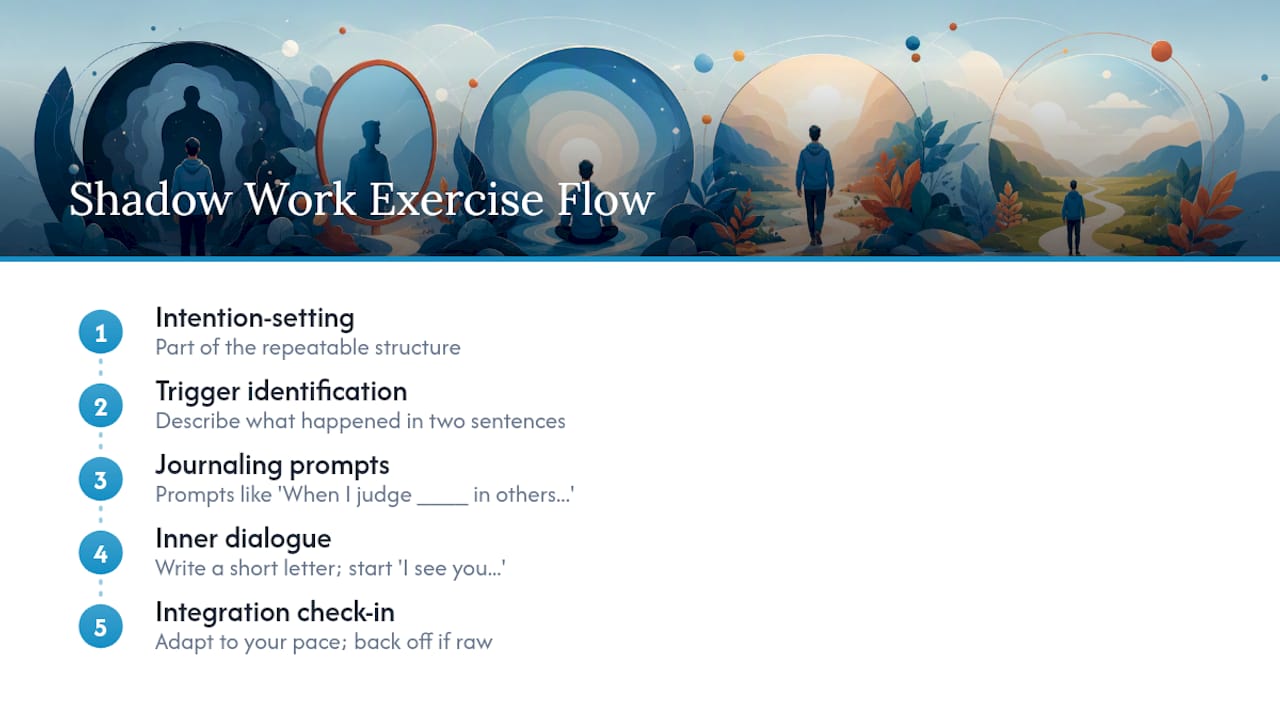
Trigger mapping (anger and reactivity): Think of a recent moment when you reacted more strongly than the situation seemed to warrant. Describe what happened in two sentences. Now write: “The real thing that felt threatened was ____.” Then: “I learned to protect this part of myself when ____.”

Inner child dialogue: Write a short letter to your younger self at the age when you first felt ashamed of ____. Don’t advise. Just acknowledge. Start with: “I see you. What happened to you was ____.”
The 3-2-1 process (adapted from integral shadow work): Pick a person who irritates you. Write three sentences describing their worst qualities in third person (“He always…”). Then shift to second person and address those qualities directly (“You always…”). Finally, shift to first person and own them: “I ____.” This exercise, which appears in various forms across shadow work guides, surfaces projection quickly.

Projection check: “When I judge ____ in others, I am usually avoiding ____ in myself.”
Shame release: “The part of me I hide most carefully is ____. I hide it because I believe others will ____. The truth I haven’t admitted yet is ____.”
Adapt any of these to your pace. If a prompt feels too raw, back off and try a lighter version: describe the situation from a distance before moving into first-person ownership.
Safety guidelines and when to get professional help
Shadow work can be emotionally intense. That’s not a warning to scare you off; it’s a structural feature of the process. You are deliberately surfacing material the psyche has kept out of conscious awareness, sometimes for decades.
The goal is integration, not excavation for its own sake. Moving too fast, or working without support, can leave you more dysregulated than when you started. Pace matters as much as depth.
Red flags that mean slow down or stop:
- Dissociation during or after a session (feeling detached from your body, surroundings, or sense of self)
- Intrusive thoughts or images that persist hours after a session
- Suicidal ideation or thoughts of self-harm
- Inability to function at work or in relationships for more than a day after a session
- Flashbacks or physical symptoms that feel like a trauma response
Grounding techniques to use immediately:
- 5-4-3-2-1 sensory check: Name five things you can see, four you can touch, three you can hear, two you can smell, one you can taste.
- Cold water: Splash cold water on your face or hold ice cubes for 30 seconds. This activates the dive reflex and slows the nervous system.
- Box breathing: Inhale for four counts, hold for four, exhale for four, hold for four. Repeat four times.
When to contact a professional: If any red flag above appears more than once, or if you’re working with trauma history, addiction, or a diagnosed mental-health condition, shadow work is best done alongside a licensed therapist, not instead of one. A therapist trained in Internal Family Systems (IFS), Jungian analysis, or somatic therapy will be familiar with shadow integration work.
U.S. crisis resources:
- 988 Suicide and Crisis Lifeline: call or text 988
- Crisis Text Line: text HOME to 741741
- SAMHSA National Helpline: 1-800-662-4357 (free, confidential, 24/7)
How to print, fill, and store your shadow work PDF
Print if you want tactile processing; use a PDF editor for repeat use or when privacy is a priority.
Print settings that work best:
- Single-sided printing on standard 8.5 x 11 paper
- At least 20 lb paper weight for writing comfort
- Punch holes and store in a three-ring binder so you can add loose pages
- Keep printed pages in a locked drawer or a folder with a non-descriptive label
Free PDF editors for digital filling:
- Adobe Acrobat Reader (free): Add text boxes anywhere on a PDF, save, and export. Available on desktop and mobile.
- Xodo: Strong mobile app for Android and iOS; lets you annotate and fill PDFs with a stylus or keyboard.
- PDF24: Browser-based, no install required; good for one-off sessions on a shared computer.
- Foxit PDF Reader: Desktop app with annotation tools and a clean interface.
Backup and privacy:
- Store digital files in a password-protected folder (use BitLocker on Windows or FileVault on Mac).
- If you use cloud storage, keep shadow work files in an encrypted folder rather than a general sync folder.
- Name files with neutral titles if others have access to your device.
Pro Tip: If you fill PDFs digitally, duplicate the blank original before your first session and keep it as a master copy. That way you can restart a workbook without re-downloading it.
Can you share or redistribute a free shadow work PDF?
The short answer: personal use is almost always fine; redistribution usually isn’t, unless the author explicitly says so.
What to check before sharing:
- Look for a copyright notice on the first or last page of the PDF.
- Check whether the author’s site lists a Creative Commons license (e.g., CC BY-NC means you can share with attribution but not for commercial use).
- If no license is stated, assume standard copyright: personal use only, no redistribution.
- Sharing a link to the author’s download page is always safe and gives the author proper credit.
How to credit an author when sharing a link: “Shadow Work Journal PDF by Zachary Phillips, available at zachary-phillips.com.”
That format covers the author’s name, the resource title, and the source. It takes ten seconds and is the right thing to do.
For commercial reuse (incorporating a free PDF into a course, workshop, or paid product), consult an intellectual property attorney before proceeding. Most free PDFs are not licensed for commercial adaptation.
What consistent workbook use actually does for you
The concept of the shadow) traces back to Carl Jung’s analytical psychology, where it referred to the unconscious parts of the personality the ego disowns. Carl Jung saw integrating the shadow as necessary for psychological wholeness, not as optional self-improvement. That framing matters because it sets realistic expectations: this is not a quick fix.
What a structured workbook reliably produces, when used consistently over weeks, is increased awareness of reactive patterns. People notice they’re less surprised by their own anger, less confused by their emotional responses to specific people or situations. That’s the first stage of integration.
The limit of self-guided work is real, though. A workbook can surface material; it cannot always help you process it safely. Readers with significant trauma histories, or those who find sessions consistently destabilizing, will get more from a workbook used alongside a therapist than from the same workbook used alone. The 30-Day Shadow Work Journal by Ryan Puusaari illustrates both the appeal and the demand of a progressive structure: daily commitment accelerates insight, but it also accelerates intensity.
A polished paid option from Ebook-warehouse
Free PDFs are a strong starting point. But if you want a workbook with guided progression, clean formatting, and a structured multi-session layout, Ebook-warehouse’s Healing Inside Out and Outside In is the paid option worth considering.

It’s designed for readers who want more than a list of prompts: a coherent arc from self-awareness through practical integration, formatted for printing or multi-device reading. If you’ve worked through a free PDF and want something more structured, this is the natural next step. For readers also interested in mindset work alongside shadow integration, Ebook-warehouse’s Money Mindset Makeover covers the psychological patterns that show up around money and self-worth. Browse the full personal development catalog at Ebook-warehouse and download instantly after purchase.
Sources
- Shadow Work Guide - Scott Jeffrey
- Shadow Light Workbook
- 30-Day Shadow Work Journal - by Ryan Puusaari