

SEO Writing Ebooks: A Practical Framework for Discoverable Books
BLUF: When it comes to seo writing ebooks, the fastest win is treating the ebook’s HTML landing page, not the PDF itself, as your primary SEO asset. Search engines read and rank web pages far better than downloadable files, and PDFs are genuinely weaker for measuring engagement or ranking signals. That matters because Google’s own guidance rewards people-first, original content, and AI assistants now pull answers from pages structured for extraction, not from a locked PDF nobody indexed.
Run this checklist before you write another word:
- Pick one narrow topic that matches a specific search intent, not a broad category.
- Build (or rebuild) the landing page with real excerpt text, chapter headings, and a clear call to action.
- Add at least one H2 that contains your target phrase, plus alt text on every cover and excerpt image.
Pro Tip: If your ebook already exists but has no dedicated landing page, that’s the single highest-leverage fix you can make this week — more than rewriting a chapter.
Key Takeaways
Ebook SEO succeeds when the HTML landing page, not the PDF, carries the keyword placement, structure, and analytics that search engines and AI assistants actually read.
| Point | Details |
|---|---|
| Landing page comes first | Build searchable excerpts and chapter headings on the HTML page before worrying about the PDF itself. |
| Match topic to intent | Validate every ebook idea against real search intent and a quick competitive gap scan before outlining. |
| Follow the placement checklist | Put the target phrase in the title tag, H1, URL slug, first paragraph, and one H2. |
| Structure content for extraction | Clear, labeled headings help both skimming readers and AI assistants pull concise answers. |
| Choose ready-made when time is tight | Ebook-warehouse’s curated titles, like The Blogging Marketing Workbook, offer a finished alternative to building from scratch. |
Table of Contents
- How to Write an SEO Ebook People Actually Finish
- SEO Ebook Tactics That Actually Move Rankings
- Building the Landing Page and Choosing a File Format
- Getting Your Ebook Found After You Publish It
- Why Trust This Framework
- Why Publish an Ebook in the First Place
- Weaving SEO Into the Writing Itself
- Measuring Whether Your SEO Ebook Is Working
- Where SEO Writing for Ebooks Usually Goes Wrong
- An Editorial Note on Discoverability Versus Gating
- Ready-Made Ebooks That Skip the Guesswork
- Sources
How to Write an SEO Ebook People Actually Finish
Most ebook projects fail before the first chapter gets written, because nobody validated the topic against real search behavior. Here’s the workflow that avoids that trap.
- Define the reader and the intent. Decide exactly who you’re writing for and whether they’re searching to learn (informational), compare (navigational), or buy (transactional). Matching content to that intent is the single biggest driver of organic visibility for any ebook topic.
- Validate the topic with a quick SERP scan. Search your candidate title and see what already ranks. If ten near-identical guides show up, you need a sharper angle or better data, not another rewrite of the same outline.
- Run a content-gap check. Reviewing top-ranking results to spot what they’re missing tells you whether to match the existing format or bring something new. A framework, a template, or a small original survey often beats generic advice competitors already published.
- Draft the chapter outline from real questions. Pull the “people also ask” phrasing and comment-section questions from your niche and turn each one into a chapter or subsection. This does double duty: it structures the book and pre-builds your landing page headings.
- Write in short work sessions, then edit separately. Draft fast without stopping to polish. Come back later specifically to cut fluff, tighten sentences, and add a case example, a screenshot, or a small data point that nobody else included.
- Design for readability, not decoration. Use a clean, single-column PDF layout with generous white space, real heading hierarchy (not just bold text pretending to be a heading), and images with proper alt text baked in before export.
A few things worth flagging as you build this out:
- Original examples beat recycled advice. If you can’t add a case study or a small dataset, at least add a worked example nobody else bothered to write out.
- Keep chapters short enough that a reader can finish one in a single sitting. Ebooks that get abandoned at chapter 3 don’t generate referrals or reviews.
- Save your outline as a living document. It becomes the skeleton for your landing page headings, your blog repurposing plan, and your email sequence later.
Pro Tip: Write your landing page copy alongside chapter one, not after the whole manuscript is done. You’ll catch keyword gaps in your outline while you can still fix them cheaply.
SEO Ebook Tactics That Actually Move Rankings
The tactics that matter for ebook SEO are almost entirely on-page and almost entirely ignored by first-time publishers. Comprehensive SEO guidance for long-form assets points to a specific checklist: title tags, heading structure, meta descriptions, URL slugs, and image tagging. Skip any one of these and you’re leaving visibility on the table.
Here’s the placement checklist worth pinning above your desk:
- Primary keyword in the title tag, H1, and the URL slug.
- Same keyword (or a close natural variant) in the first paragraph of the landing page.
- At least one H2 that contains the keyword or a direct variant, without repeating it word for word in every heading.
- A meta title that leads with the benefit, then the phrase: “The Content Marketer’s Guide to SEO Ebooks: Templates Included,” not “SEO Ebooks Guide.”
- A meta description that states what’s inside and gives a reason to click, kept under 155 characters.
- Descriptive, hyphenated image filenames and specific alt text (“seo-ebook-chapter-outline-template.png,” not “image1.png”).
Content becomes citable by AI systems only when it’s sectioned and labeled clearly enough for a model to extract a concise answer, which is exactly why the heading structure matters as much as the keyword itself. A wall of unlabeled text, however well written, gives AI assistants and human skimmers nothing to grab onto.
Schema markup adds one more layer. Product or Book schema on the landing page helps search engines understand what’s being sold and can surface rich results like star ratings or price. FAQ schema, where genuinely relevant, gives you another shot at featured placement. Neither replaces good on-page writing. Both amplify it.
Building the Landing Page and Choosing a File Format
Your landing page carries the SEO weight, so it needs more than a cover image and a “Buy Now” button. Include a searchable excerpt (300 to 500 words of real chapter content), a visible table of contents with chapter headings, and a CTA that’s specific about what happens next.

On format: PDF remains the default for most niche and self-published ebooks because it renders identically everywhere and prints cleanly. EPUB matters when your audience reads primarily on e-readers or phones and needs reflowable text. When budget allows, offer both and let the download page ask the reader’s preference rather than guessing.
A short technical list to run before launch:
- Set a canonical tag on the landing page so it doesn’t compete with the PDF file itself in search results.
- Consider a robots directive on the raw PDF URL if you want all authority flowing to the HTML page instead.
- Fire an analytics event on the download button so you can measure conversion, not just pageviews.
- Use real heading tags and alt text on the landing page so screen readers, and search engines, can parse the structure correctly.
Getting Your Ebook Found After You Publish It
Writing the book is half the job. Getting it in front of the right readers is the other half, and it’s where most independent publishers quit too early.
- Use it as a lead magnet. Gate the download behind an email opt-in if list-building matters more to you than raw traffic volume. If discoverability matters more, keep it open and let search do the work instead.
- Repurpose chapters into blog posts. The strongest-performing ebook programs pair a hub landing page with individual blog posts syndicated from each chapter, each one linking back to the main page. That single move creates internal links, topical depth, and more entry points from search.
- Run targeted outreach. Pitch resource-page editors in your niche, offer a guest post that excerpts one chapter, and ask satisfied readers for a short public mention you can reference later.
- Decide on marketplace listing case by case. Wide distribution builds visibility fast; keeping the asset exclusive to your own site protects your email list and your landing page’s authority.
Pro Tip: Publish the blog-post version of your best chapter two weeks before the ebook launch. It gives search engines something to index and rank while you finish the rest of the funnel.
Why Trust This Framework
Ebook-warehouse built its catalog around curated, niche-specific titles across business, personal development, and content creation, which means the workflow above comes from watching what actually sells and gets read, not from theory alone. Multi-device access and a focused editorial process shape every title added to the collection.
The publishers who treat an ebook as a single marketing asset, not a one-off PDF, are the ones whose books keep generating traffic a year after launch.
Author note: Stephen’s editorial work centers on ebook curation and digital marketing strategy across Ebook-warehouse’s catalog, informing the practical workflow outlined here.
Why Publish an Ebook in the First Place
An ebook earns its place in a marketing plan three ways: as a lead magnet that trades a chapter’s worth of value for an email address, as a credibility signal that shows you’ve thought through a topic more deeply than a blog post allows, and as a quiet sales funnel that warms up a reader before you ever mention a paid product.
None of those goals require the same ebook. A lead magnet works best short and specific, solving one narrow problem in twenty pages. An authority piece can run longer and denser, because the reader arrived already convinced you know the subject. A funnel piece needs a clear bridge at the end, pointing toward the next step, whether that’s a course, a service, or another book.
Decide which job the book is doing before you outline it. A 40-page book trying to be a lead magnet, an authority statement, and a sales pitch all at once usually fails at all three, because the writing keeps shifting registers and the reader can feel it.
Weaving SEO Into the Writing Itself
On-page SEO for ebooks isn’t just landing-page metadata. The manuscript itself benefits from the same discipline. Chapter titles that mirror how readers actually phrase their questions outperform clever, vague titles every time, both inside the book and when repurposed as headings on the site.
Write each chapter so the first paragraph states what it covers, plainly. That single habit does two jobs: it helps a skimming reader decide whether to keep going, and it gives you a ready-made pull-quote or excerpt for the landing page later. Break up long sections with subheadings every few hundred words, the same way you’d structure a web page, because most readers now expect that rhythm even in a downloaded file.
Original examples carry more weight than restated advice. A worked case, a small before-and-after comparison, or a short original checklist gives the book something to be cited for, inside search results and inside AI-generated answers that summarize what your book actually says.
Measuring Whether Your SEO Ebook Is Working
Downloads alone tell you almost nothing. Track the landing page’s organic traffic, the download-button conversion rate, and time on page as your core trio. A page pulling steady search traffic but converting under 2% on the download button usually has a mismatch between the promise in the title and the offer behind the button.
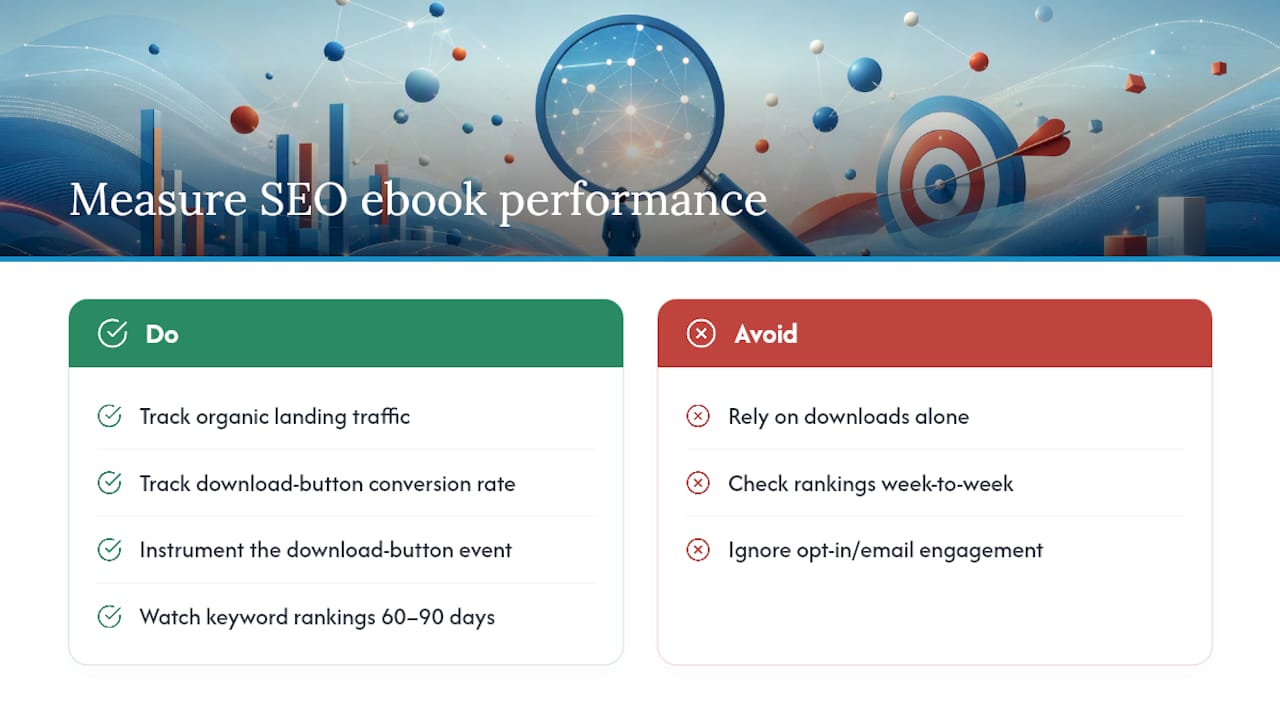
Instrumenting the download button with an analytics event lets you separate visitors from actual downloads, which changes how you read every other number on the page. Watch keyword rankings for your target phrase over 60 to 90 days rather than week to week; ebook landing pages tend to climb slowly as backlinks and repurposed blog content accumulate.
If you gated the book behind an email opt-in, add opt-in rate and, further downstream, email engagement from that specific list segment. A book that generates opens but no clicks later usually solved the wrong problem for that audience.
Where SEO Writing for Ebooks Usually Goes Wrong
The most common failure is publishing the PDF and calling it done, with no landing page, no excerpt, and nothing for search engines to actually crawl and rank. Fix that first, before touching anything else on this list.
The second failure is keyword stuffing the manuscript itself, repeating the target phrase until sentences read like they were written for a bot rather than a person. Google’s own guidance rewards content that demonstrates real, original experience over mechanical optimization, and readers notice the awkward repetition immediately.
The third failure is picking a topic too broad to rank for or too broad to actually deliver on in twenty or thirty pages. “A Guide to Marketing” competes with everyone. “A 14-Day Content Calendar for Solo Consultants” competes with almost no one, and it’s a book you can actually finish.
The fix for all three is the same: build the landing page first, write toward a narrow promise, and let the manuscript sound like a person talked through a real problem, because that’s usually what ranks and gets cited anyway.
An Editorial Note on Discoverability Versus Gating
We weigh discoverability against email capture on every title. A broad how-to sells better ungated; a template-heavy workbook earns more as a lead magnet behind an opt-in.
— Stephen
Ready-Made Ebooks That Skip the Guesswork
Everything above assumes you’re writing your own book from scratch, which takes real time even with a tight workflow. If you’d rather start from something already built, Ebook-warehouse’s catalog gives you finished, niche-specific titles you can read, apply, and repurpose immediately, without the six-week production cycle.
If your goal is turning chapters into ongoing blog content and internal links, The Blogging Marketing Workbook walks through that exact repurposing process step by step. If you’re closer to building an ebook business yourself, E-Book Entrepreneur covers the publishing side directly, with templates rather than theory. Every title downloads instantly and works across your phone, tablet, or laptop, so there’s no waiting on shipping or file conversion.
Browse the catalog, pick the title that matches the gap in your own workflow, and download it today. That’s the fastest path from “I should really write this” to having a working framework in hand this afternoon.
Sources
You don’t need twenty resources. You need the right five.
- Creating helpful, reliable, people-first content | Google Search Central
- SEO content: A complete guide for search and AI | Semrush
- SEO content / website-technology (MSU)
- Why your PDFs are killing your B2B SEO and how to fix it