

7 Steps To Turn Email Marketing Ebooks Into Live Campaigns
Start with a foundational workbook from Ebook-warehouse’s curated email marketing collection, then pair it with a current “State of Email” trend report. That combination gives you templates you can act on today plus the context to know which tactics still work in 2026. Expect ready-to-use frameworks for subject lines, welcome flows, and list building, not just theory.
TL;DR:
- Choose workbooks that include editable templates and exercises to build practical skills, rather than relying solely on explanation or theory.
- Prioritize guides with recent update dates and content on deliverability, authentication, and AI personalization to stay current in 2026.
- Pair foundational workbooks with trend reports to ensure tactics are aligned with the latest email reading behaviors and subscriber expectations.
- Focus on applying specific, tested tactics like subject-line formulas and segmentation through small, measurable tests over multiple campaign cycles.
- For seasoned marketers, select more advanced guides covering cross-channel strategies and real campaign examples to deepen strategic understanding.
Table of Contents
- Best Email Marketing Ebooks Worth Downloading Right Now
- What These Ebooks Actually Teach You
- How to Choose the Right Email Marketing Ebook for Your Needs
- Free Reports and Vendor Guides Worth Pairing With Your Ebook
- A 7-Step Framework for Turning an Ebook Into Better Campaigns
- Why Ebook-warehouse Curates Practical Email Marketing Collections
- Where to Find Email Marketing Ebooks: Formats and Platforms
- Free vs. Paid Email Marketing Ebooks: What You Actually Get
- How to Combine Multiple Ebooks Into One Learning Path
- Author Credentials Worth Checking Before You Buy
- The Case Against Reading Just One Email Marketing Ebook
- Start Building Your Email Skills Today
- Sources
Best Email Marketing Ebooks Worth Downloading Right Now
Picking the right resource matters more than picking the most popular one. A beginner who grabs a dense B2B deliverability manual will stall out; a growth lead who buys a “getting started” pamphlet will outgrow it in a week. Here’s a shortlist organized by what each resource actually delivers, not just its title.
- Foundational email marketing workbook (Ebook-warehouse) — best for beginners who want to learn by doing; teaches list building, email types, and copywriting through fill-in exercises rather than lectures. Workbook format, plan for multiple sittings.
- The Blogging Marketing Workbook — best for content creators building an email list around a blog or newsletter; teaches how to turn posts into subscriber-generating lead magnets. Workbook, moderate time investment.
- Marketing strategy ebook collection — best for readers who want the “why” behind campaign structure before touching a template; covers positioning and messaging strategy. Quick read.
- Digital marketing ebook collection — best for marketers who need segmentation and cross-channel context around their email work. Deep dive, several chapters.
- Email Marketing Tips — best for anyone who wants tactical fixes today: subject-line formulas, send-time guidance, quick wins. Quick read, single sitting.
- A concise beginner guide on the basics — covers how to build a list, the core email types, and how to write your first campaign in short, implementable chapters, similar in spirit to the free primer from the eMarketing Institute.
- A classic email marketing reference — useful for subject-line psychology and frequency theory; older material but the underlying principles still hold, as archived in resources like the Internet Archive’s email marketing guide.
- E-Book Entrepreneur — best for readers who want to monetize a list, not just grow one; bridges email marketing into product and info-product sales.
What These Ebooks Actually Teach You
Every solid email marketing ebook covers a predictable set of modules, but the depth varies a lot between a quick read and a full workbook. Here’s what to expect chapter by chapter, and roughly how long each takes.
- List building and opt-in mechanics (30–45 minutes) — lead magnets, signup forms, and consent basics.
- Email types and cadence (20–30 minutes) — newsletters, promotional sends, transactional triggers, and how often to send each.
- Subject lines and open rates (30 minutes) — psychology-driven formulas, drawn from foundational theory that classic guides still cover well.
- Welcome flows (45–60 minutes) — sequence length, timing between emails, and subject-line testing for your first automated series.
- Segmentation (30–45 minutes) — splitting lists by behavior, purchase history, or engagement level.
- Deliverability and authentication (45–60 minutes, advanced) — SPF, DKIM, and sender reputation, usually reserved for intermediate-to-advanced guides.
- AI personalization (30 minutes, advanced) — dynamic content and predictive send-time tools, a fast-growing focus in 2026 industry trend coverage.
- Metrics and reporting (20–30 minutes) — open rate, click-through rate, and conversion tracking tied back to campaign goals.
Quick guides tend to compress steps 1 through 3 into a single sitting. Workbooks stretch steps 4 through 8 across exercises you complete over days, not minutes.
How to Choose the Right Email Marketing Ebook for Your Needs
Run through a short checklist before you download anything. Does the ebook include templates you can copy and edit, or is it pure explanation? Is there a publication or update date, since deliverability rules and platform features shift fast? Does it include case studies or real campaign examples, not just abstract advice? And how much time will implementation realistically take, given your current workload?
Three reader types tend to need three different starting points:
- Beginner solo marketer — start with a foundational workbook that walks through list building and your first few campaigns step by step.
- B2B growth lead — prioritize guides with segmentation and personalization chapters, and lean on tactical resources like LeadPilot’s cold email personalization playbook for outreach-specific techniques.
- In-house marketing manager — pick a deeper strategy guide that covers cross-channel coordination, since you’re likely answering to stakeholders who want more than open rates.
Red flags worth skipping: no editable templates, no visible update date, and no mention of deliverability or authentication at all.
Pro Tip: If an ebook doesn’t tell you how long each chapter takes to implement, block out 20 minutes yourself and test the first template before committing to the whole book.
Free Reports and Vendor Guides Worth Pairing With Your Ebook
A practical workbook teaches you the mechanics. A trend report tells you whether those mechanics still match how people read email in 2026. Pairing the two is how you avoid learning tactics that quietly stopped working two years ago.
Current benchmarking reports highlight AI-driven personalization, updated email design systems, and free-to-paid conversion strategies as the dominant themes shaping campaigns this year, according to Knak’s 2026 trends coverage. Four resources worth checking alongside your primary ebook:
- A current “State of Email” trend report — answers what’s changing in deliverability, AI tools, and subscriber expectations.
- A definitive strategy guide — outlines the traits of genuinely engaging email, including being trusted, relevant, and coordinated across channels.
- A vendor playbook, such as Zoho Campaigns’ ebook library — answers how specific metrics and authentication updates play out in a live platform.
- A tactical checklist ebook — answers which core components (offer, audience, welcome flow) show up across successful campaigns.
A 7-Step Framework for Turning an Ebook Into Better Campaigns
Reading a workbook does nothing until you apply it to a live send. This framework, drawn from the structure most practical ebooks already follow, turns chapters into a testable campaign in a week.
- Set one objective — more replies, more sales, more signups. Pick one.
- Define your audience segment — who specifically gets this email, and why they’re different from your full list.
- Draft the content concept — the single idea the email communicates.
- Sharpen your value proposition — what the reader gets that they can’t get elsewhere.
- Choose your acquisition angle — how this email earns attention in a crowded inbox.
- Build or refine your welcome flow — timing, sequence length, and subject-line variants for new subscribers.
- Add tactical elements — a clear call to action, mobile-friendly formatting, and a subject line pulled straight from your ebook’s formulas.
Pick one concrete change to test: a subject-line A/B test, a rewritten welcome message, or a segment-specific offer. Run it for at least two full send cycles, tracking open rate, click-through rate, and conversion. Marketo’s research on engaging email found that trusted, conversational messaging coordinated across channels consistently outperforms one-off broadcast blasts, which is the benchmark worth testing against.
Why Ebook-warehouse Curates Practical Email Marketing Collections
Ebook-warehouse builds carefully curated lists rather than dumping every PDF into one category. Every title downloads instantly and syncs across your devices, so a workbook you start on a laptop finishes on your phone during a commute. The difference between a curated path and a scattered folder of free PDFs is sequencing: you move from foundational list building to advanced segmentation in an order that actually builds skill, instead of guessing which chapter to read next.
Where to Find Email Marketing Ebooks: Formats and Platforms
Email marketing books show up in more formats than most readers expect, and each one fits a different reading habit. PDF remains the most common format because it preserves layout, tables, and templates exactly as designed, which matters when a workbook includes fillable worksheets or screenshot examples.
EPUB and MOBI formats work better for e-readers and offer reflowable text, useful for pure-theory guides you’ll read cover to cover rather than reference repeatedly. Some publishers also release ebooks as interactive web pages or gated PDF downloads tied to an email signup, common with vendor playbooks from platforms like Zoho Campaigns.
As for where to find them: digital bookstores and dedicated ebook retailers like Ebook-warehouse offer instant downloads with multi-device access, no waiting for a gated form or a follow-up sales email. Vendor sites (email platform providers) publish free playbooks tied to their own tools, useful for platform-specific tactics but sometimes light on general strategy. Archive sites host older, foundational titles worth reading for theory even when the interface examples look dated. Marketing blogs and roundup sites curate seasonal “best ebooks” lists, useful for discovery but rarely a substitute for reading the actual material.
The format matters less than whether you can actually open and use it on the device where you’ll do the work, which is where a straightforward download beats a PDF trapped behind a marketing funnel.
Free vs. Paid Email Marketing Ebooks: What You Actually Get
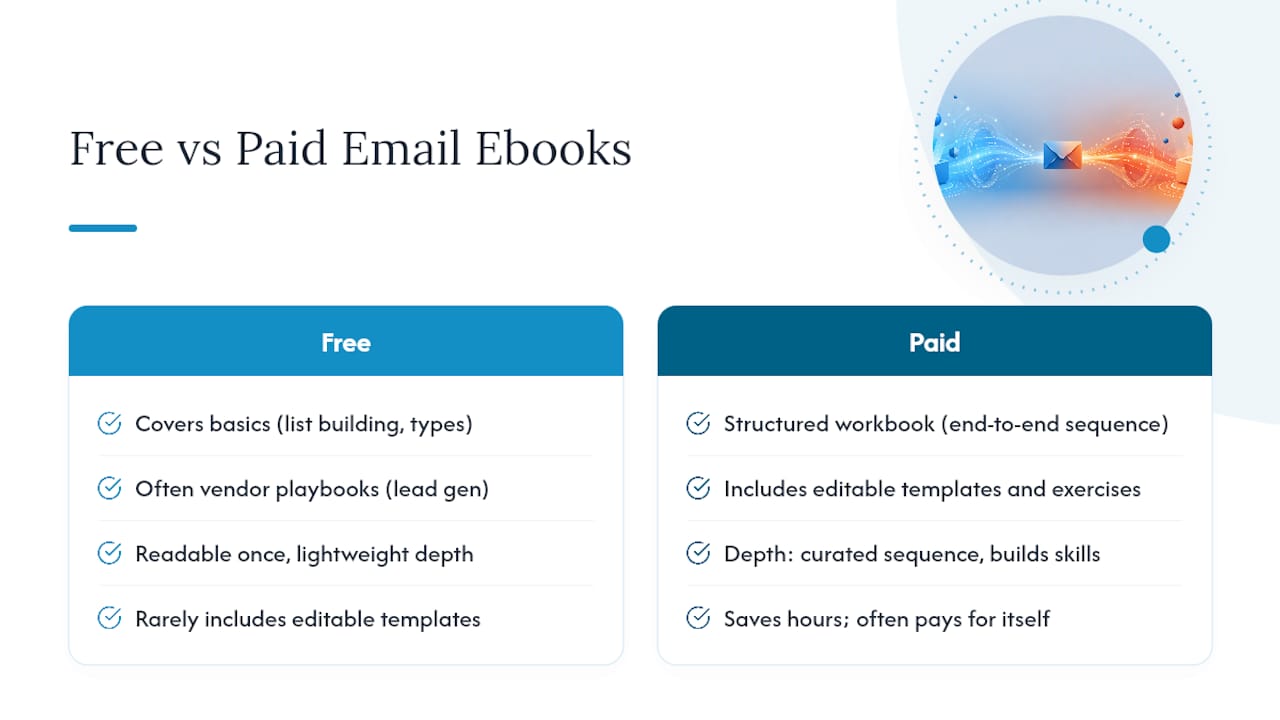
Free ebooks are genuinely useful for the basics. A concise beginner guide covering list building, email types, and how to write your first send can get someone from zero to a working campaign in an afternoon, and resources like the eMarketing Institute’s beginner guide prove that free doesn’t mean thin. Vendor playbooks are free too, usually because they double as lead generation for a paid platform, but the tactical content inside is often genuinely solid.
Where free content tends to fall short is depth and structure. Free guides rarely include editable templates, structured exercises, or a sequence that builds one skill on top of another. They’re built to be read once, not returned to.
Paid workbooks earn their price through structure: templates you edit instead of recreate, exercises that force application instead of passive reading, and a curated sequence that takes you from list building through segmentation without guessing what to read next. If you’re testing whether email marketing is worth your time at all, start free. If you’re already running campaigns and losing time rebuilding templates from scratch, a paid workbook usually pays for itself in the hours it saves on the first campaign alone.
The honest value assessment: free for orientation, paid for execution.
How to Combine Multiple Ebooks Into One Learning Path
No single ebook covers everything you need, and treating one book as a complete education is the most common mistake beginner marketers make. The fix is sequencing, not more reading.
Start with one foundational resource that covers list building and your first campaigns. Layer in a strategy-focused guide once you understand the mechanics, since strategy without execution skill just produces good ideas you can’t act on. Add a trend report, like the 2026 email marketing trends overview, once your basics are solid, so you’re applying current tactics instead of outdated ones. Finish with a specialized guide for your specific gap, whether that’s B2B personalization, deliverability, or monetization through something like an entrepreneurial email product.
The order matters more than the volume. Reading four ebooks in the wrong sequence, strategy before mechanics, or trends before fundamentals, wastes time re-reading later. Reading four in the right order compounds: each one reinforces the last instead of introducing new confusion.
Author Credentials Worth Checking Before You Buy
Not every name on an ebook cover deserves your trust, and checking credentials takes thirty seconds. Look for authors with direct campaign management experience, not just content writers repackaging other people’s frameworks. A background running actual email programs, whether in-house or agency-side, shows up in the specificity of the examples: real subject lines, real open-rate ranges, real mistakes.
Certifications from recognized marketing education platforms add credibility, particularly for authors covering technical topics like deliverability or authentication protocols, where getting the details wrong actively hurts your sender reputation. Published track records matter too. An author who has written multiple editions or updated their material to reflect platform changes is more trustworthy than one who published once and never revisited the content as email standards shifted.
Watch for vague author bios that mention “years of experience” with no specifics, no named companies, no measurable results. That vagueness usually signals theory without practice. The strongest ebooks name real campaigns, real numbers, and real platforms, because that specificity is what separates an author who has run email programs from one who has only read about them.
The Case Against Reading Just One Email Marketing Ebook
Most people treat their first email marketing ebook like a finish line instead of a starting point. That’s backwards. The strongest reader outcomes come from combining a hands-on workbook with a current trend report, not from finding one perfect book that covers everything.
Here’s what the conventional advice gets wrong: it treats deliverability and AI personalization as advanced, optional chapters you can skip until later. In 2026, those aren’t advanced topics anymore. They’re table stakes. A beginner who skips authentication basics will watch their welcome flow land in spam before they ever learn why their open rate looks broken.
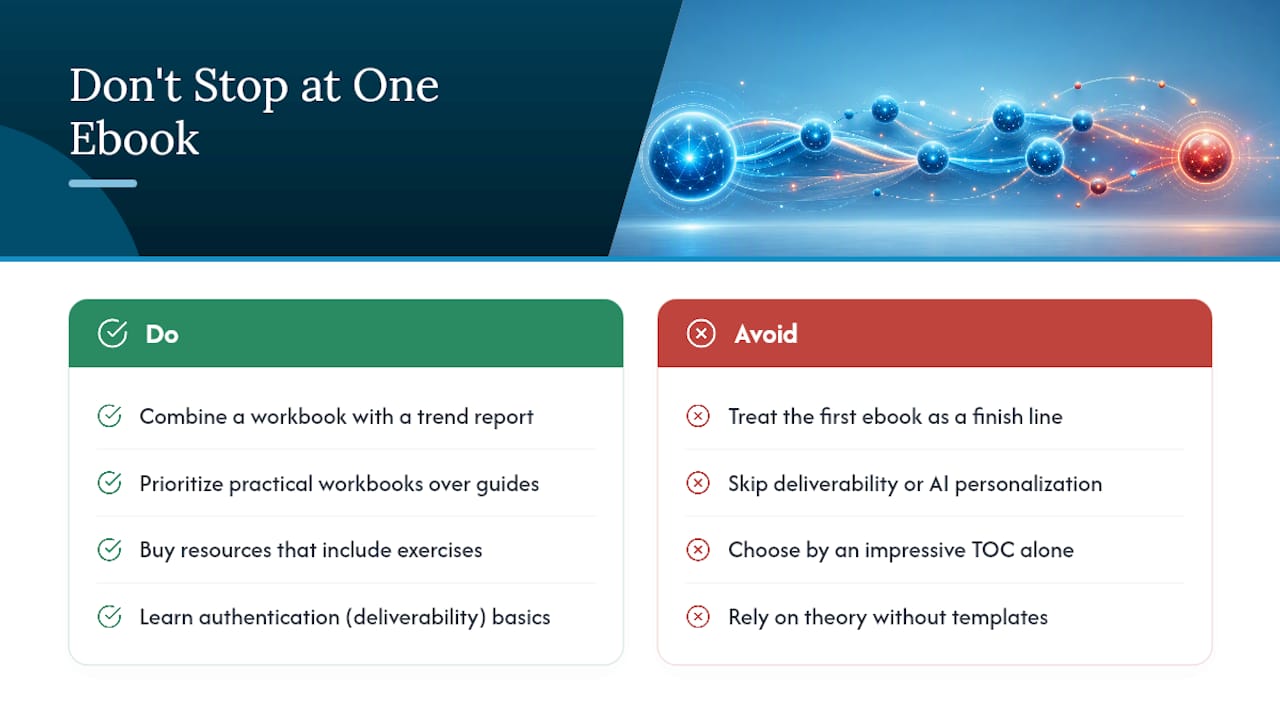
Prioritize practical workbooks over pure strategy guides if you have to choose one. Theory without a template to act on produces good intentions and no campaigns. A workbook forces you to write the actual subject line, build the actual segment, draft the actual welcome sequence. That’s the gap between reading about email marketing and doing it.
If you take one thing from this list, take this: buy the resource with exercises, not the one with the most impressive table of contents.
— Stephen
Start Building Your Email Skills Today
Ebook-warehouse gives you something most scattered free PDFs can’t: a curated sequence you can download instantly and pick up again on any device, without hunting through gated forms or outdated blog posts. If you’re building toward a broader skill set, that same instant-access model applies well beyond email. The Personal Productivity workbook pairs naturally with your email templates if you’re managing campaigns alongside a full workload, helping you protect the time you need to actually run the tests you just read about.
For readers building confidence alongside their marketing skills, the Boosting Self Esteem guide and the Developing Emotional Intelligence workbook both support the softer skills that make writing persuasive, trustworthy email easier. Ebook-warehouse regularly runs buy-three-get-one-free promotions, so stacking a workbook, a trend guide, and a skills resource together often costs less than buying them one at a time. Browse the collection and download your first workbook now to start testing this week’s campaign changes.
Sources
- 2026 email marketing trends | Knak
- The Definitive Guide to Engaging Email Marketing | Marketo
- Effective e-mail marketing : the complete guide to creating successful campaigns | Internet Archive
- Zoho Campaigns ebooks
- Email Marketing for beginners | eMarketing Institute