

4 Week Grade Boost: eBook Warehouse Study Skills Ebooks for Students
The fastest path to better grades is a short, downloadable study-skills ebook that trains retrieval practice and spaced review instead of just explaining them. Start with a focused title like eBook Warehouse’s Personal Productivity or Developing Emotional Intelligence, pair it with a free quick-tips guide for variety, and run both through a simple four-week plan. That combination beats reading five different blog posts about “how to study better.”
TL;DR:
- The most effective study guides include exercises and evidence-based techniques like retrieval practice, spacing, and interleaving to promote durable learning.
- Short quick guides are ideal for immediate fixes, while comprehensive handbooks suit those rebuilding their entire study system over a semester.
- A four-week structured plan involving assessment, routine building, interleaving, and measurement significantly improves learning outcomes.
- Prioritize ebooks with practical exercises and printable worksheets over those limited to theory to ensure active engagement and skill development.
- Focusing on relevant problems, such as time management or motivation, helps select the most effective study guide for your specific needs.
Table of Contents
- Downloadable Study Skills Ebooks Worth Your Time
- How to Choose the Right Study Skills Ebook
- The Study Methods a Good Ebook Should Actually Teach
- A Four-Week Plan to Use Any Study Ebook
- Why Most Study Advice Skips the Part That Matters
- Start With These eBook Warehouse Picks
- Sources
Downloadable Study Skills Ebooks Worth Your Time
Not every study guide deserves a spot on your device. The best ones fall into three categories: quick guides you finish in an afternoon, full handbooks you work through over a semester, and topic-focused ebooks that solve one specific problem like procrastination or exam anxiety.
Quick guides. These are built for students who need a fix now, not a philosophy lesson. University library guides and publisher hubs like SAGE’s free study skills collection tend to bundle short, worksheet-heavy booklets that work well for a weekend reset before midterms. They skip the theory and go straight to checklists.
Full handbooks. When you need structure across an entire term, something like The Study Skills Handbook format works better than a quick guide. These combine time management, note-making, and revision templates into one reference you return to again and again, which matters if your problem isn’t one bad habit but a whole system that needs rebuilding.
Topic-focused ebooks from eBook Warehouse. This is where things get specific:
- Personal Productivity tackles time management and scheduling head-on, with a structure built for students juggling classes, jobs, and deadlines. Best for anyone who knows what to study but keeps running out of hours to do it.
- Developing Emotional Intelligence addresses the motivation and self-regulation side of studying, the part most study guides skip entirely. Best for students who understand the techniques but struggle to sit down and use them consistently.
- Home School Strategies is built for learners studying outside a traditional classroom structure, with templates for building routines without a bell schedule to keep you honest. Best for homeschooled students or anyone managing fully self-directed study.
- Boosting Self Esteem targets the confidence gap that derails exam performance even when preparation is solid. Best for students whose anxiety, not their knowledge, is the actual bottleneck.
For free options, check your school library’s guides page first. Most universities publish a version of the Western Washington University study skills booklet, which covers Cornell notes and scheduled review checklists at no cost. You can usually find these under “academic success” or “learning commons” on any university library site, no login required.
Arrange your shortlist by the problem you actually have, not the topic that sounds impressive. A time-management problem needs Personal Productivity, not a 300-page handbook on essay writing.
How to Choose the Right Study Skills Ebook
Picking an ebook is less about the topic on the cover and more about what’s inside the chapters. Run any candidate through this checklist before you buy or download:
- Does it include exercises, not just explanations? A book that only describes retrieval practice without giving you a self-test template isn’t going to change your behavior.
- Are the techniques evidence-based? Look for mentions of spacing, interleaving, or self-testing rather than vague “study smarter” advice with no mechanism behind it.
- How long is it, realistically? A 20-page quick guide fits into a weekend. A 200-page handbook needs a semester-long commitment. Match the length to how much time you actually have.
- Is the format compatible with your devices? Confirm whether it’s a PDF or EPUB and whether worksheets print cleanly, since format and printable-worksheet support vary by title and this matters if you study offline.
- Does the price match the depth? A free 15-page booklet and a paid 150-page handbook solve different problems. Paying more only makes sense if you need the extra structure.
If your goal is a quick behavior fix, like breaking a cramming habit before finals, a short guide with worksheets beats a comprehensive textbook. If you’re rebuilding your entire approach to studying from the ground up, the deeper handbook earns its price.
Pro Tip: Before buying, open the table of contents and scan for the word “exercise,” “worksheet,” or “practice.” If those words barely appear, the ebook is probably a summary of ideas rather than a tool you’ll actually use.

The Study Methods a Good Ebook Should Actually Teach
Most study advice fails because it’s about information, not retrieval. Rereading a chapter feels productive, but it mostly builds familiarity, not memory. The techniques below are the ones with real staying power, and any ebook worth downloading should build its exercises around them.
- Retrieval practice. Testing yourself on material, rather than rereading it, forces your brain to reconstruct information instead of recognize it. A good ebook exercise: cover your notes and write down everything you remember about a topic, then check what you missed.
- Spacing. Reviewing material across several days beats cramming it into one session, even when total study time is identical. Look for a spaced-review schedule template, something like reviewing new material after one day, then three days, then a week.
- Interleaving. Mixing problem types within a single study session, instead of drilling one type repeatedly, builds the ability to recognize which method a problem needs, not just how to execute it once you know.
- Desirable difficulties. Learning tasks that feel harder in the moment, like generating your own test questions instead of reading provided ones, tend to produce more durable retention.
These aren’t fringe ideas. Make It Stick built its entire case around retrieval, spacing, and interleaving outperforming passive rereading across a wide range of subjects and skill levels. An ebook that skips these in favor of highlighting tips and color-coded notes is teaching you to feel prepared, not to be prepared. The gap between those two states is exactly where most exam-day surprises come from.
A Four-Week Plan to Use Any Study Ebook
Buying the ebook is the easy part. Turning it into a grade improvement takes a structure, not just good intentions.
- Week 1: Assess and choose. Read the ebook’s first two chapters and pick two techniques to try, no more. Trying everything at once is how most study plans quietly die by day four.
- Week 2: Build the routine. Schedule short daily sessions using retrieval practice (self-test prompts from the ebook) and set up a spaced-review calendar for the material you’re learning now.
- Week 3: Interleave and stress-test. Mix problem types or topics within single sessions instead of studying one subject block at a time. Note where you’re still guessing versus genuinely recalling.
- Week 4: Measure and adjust. Compare your self-test scores from week 1 to week 4. If a technique isn’t moving the needle, swap it for another one from the ebook rather than abandoning the plan entirely.
This mirrors the self-regulated learning cycle that study-skills researchers recommend: assess, choose a small number of strategies, implement with scheduled practice, then measure results before deciding what changes next.
Pro Tip: Keep a one-line log after every study session, just the technique you used and a rough confidence score out of 10. After four weeks you’ll have actual data instead of a gut feeling about what worked.
Why Most Study Advice Skips the Part That Matters
The conventional wisdom around studying spends too much time on tips and not enough on repetition. Every “10 study hacks” listicle recommends the same five things: use flashcards, find a quiet space, take breaks, highlight key points, get enough sleep. None of that is wrong, exactly, but none of it addresses the actual mechanism that builds memory.
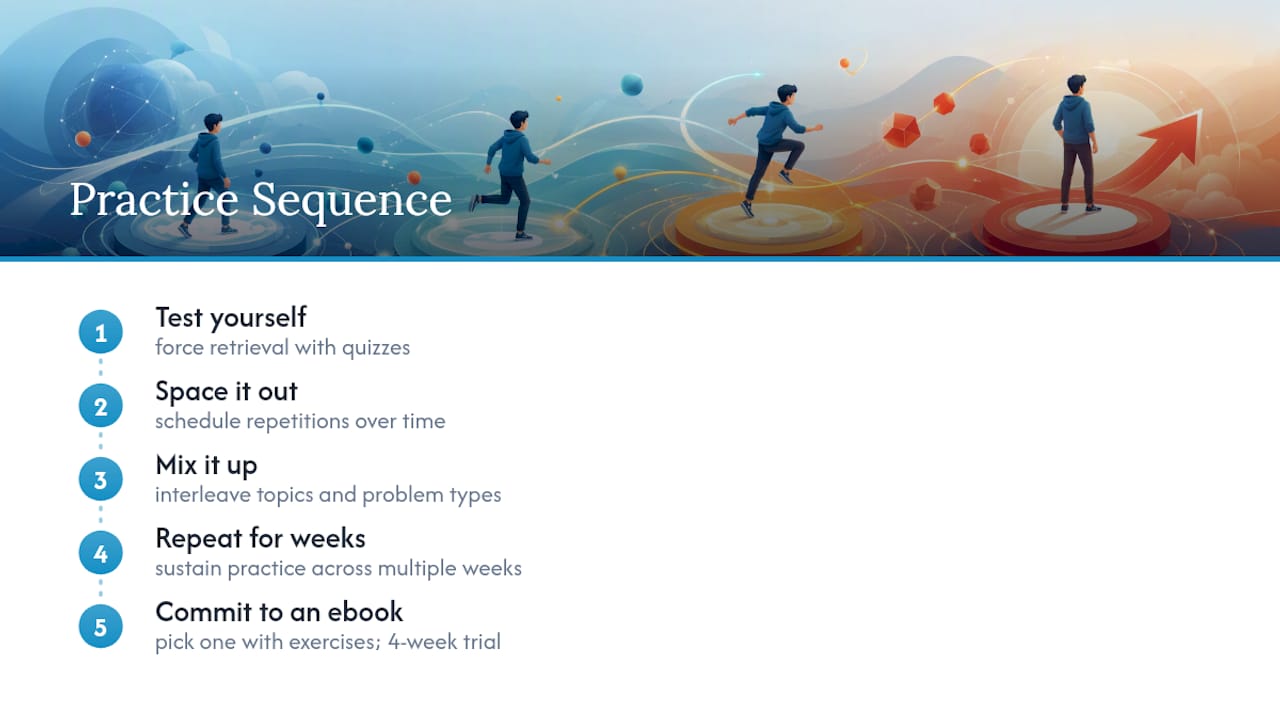
What the research keeps pointing back to is boring by comparison: test yourself, space it out, mix it up, repeat for weeks. Students often mistake the comfort of rereading for actual progress, and an ebook that forces retrieval through quizzes breaks that illusion faster than any motivational chapter ever will. That’s the real value of a good study-skills ebook over a free blog post. A blog post gives you the concept once. A well-built ebook gives you the exercise, the schedule, and the checklist to make the concept stick.
If I had to prioritize one thing for a student picking their first ebook, it wouldn’t be finding the “best” title. It would be picking any title with real exercises and committing to it for four weeks before judging whether it worked. Most people quit techniques before the technique had a chance to prove itself.
— Stephen
Start With These eBook Warehouse Picks
Every recommendation above comes down to the same checklist: real exercises, evidence-based techniques, and a format you can actually use on the device in front of you. eBook Warehouse’s study-focused titles are built around exactly that structure, with concise chapters and printable worksheets rather than pages of theory you’ll skim past.
If your biggest obstacle is sitting down to study in the first place, Developing Emotional Intelligence tackles the motivation and self-regulation side that most study guides ignore. If your problem is fitting study time into an already packed schedule, Personal Productivity gives you the time-blocking and scheduling tools to make that happen. And if you’re studying outside a traditional classroom setup, Home School Strategies offers routines built for exactly that situation. Every title downloads instantly and works across your devices, so you can pick one now and start your four-week plan tonight.
Sources
- Make It Stick | Science‑Backed Learning Strategies That Really Work
- Study skills booklet (Western Washington University)